
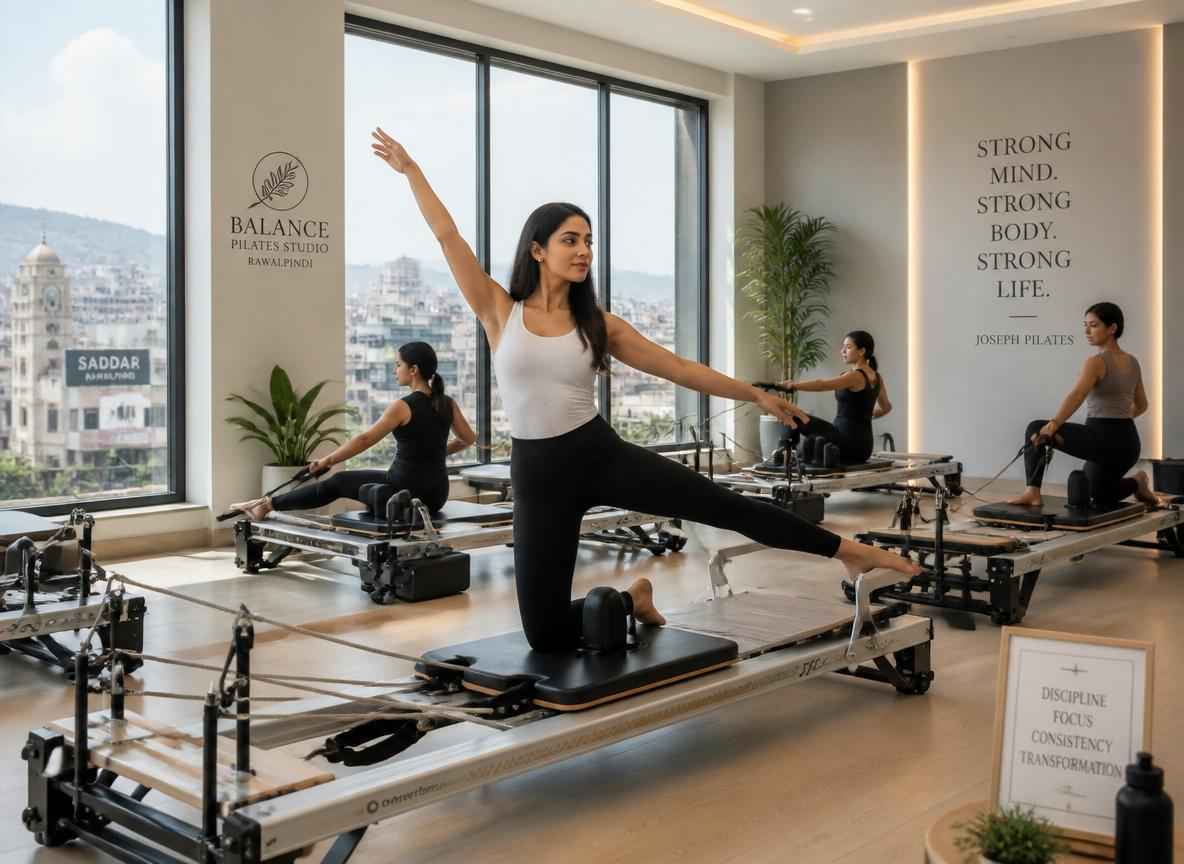
Reformer Pilates Studio in Rawalpindi | 2026 Guide
You've probably heard about reformer Pilates. Maybe a friend described it, you saw it on social media, or you've been curious about that bed-like machine with the springs and the sliding carriage. The question most people have isn't "what is it" — they've answered that already. The real question is whether a reformer Pilates studio produces results that a regular gym or mat class simply can't, and whether it's worth committing to. This guide answers both. It covers how the reformer works, what it does that mat Pilates doesn't, who benefits most, and what to look for in a studio before you book your first session.
What the Reformer Machine Actually Is
A Pilates reformer is a spring-resistance apparatus consisting of a sliding carriage mounted on a horizontal frame, connected to an adjustable spring system, footbar, shoulder blocks, and a set of ropes and pulleys. The machine was developed by Joseph Pilates during World War I, when he attached springs to hospital beds so that injured and bedridden patients could exercise and rebuild muscular function without standing. Those original spring beds became the foundation of what is now used in every professional reformer Pilates studio worldwide.
The mechanics haven't changed much since Pilates formalized the design in the 1920s. What has changed is the understanding of why those mechanics work so effectively. The sliding carriage creates an unstable surface. The spring resistance can be increased or decreased to change the challenge level. Every exercise performed on the reformer requires the body to generate continuous stabilization through the core, hips, and spine while the carriage moves, which activates deep muscle groups that standard gym machines and bodyweight training consistently miss.
As of 2026, the global Pilates reformer market is valued at approximately USD 8.29 billion, according to Business Research Insights, and is projected to reach USD 16.81 billion by 2035 at a compound annual growth rate of 8.2%. That growth is not driven by marketing. It reflects measurable clinical outcomes that are bringing reformer Pilates into physiotherapy clinics, rehabilitation centers, and corporate wellness programs worldwide.
What a Reformer Pilates Studio Offers That a Gym Cannot
Most gyms that list "Pilates" on their service menu offer mat classes. Some offer reformer access as an add-on. Neither of these is a reformer Pilates studio. The distinction matters because the way the equipment is used, maintained, sequenced, and instructed determines whether clients get results or just complete sessions.
A dedicated reformer Pilates studio is built around the machine as the central training tool. Instructors in a proper studio are trained specifically on reformer technique, spring tension selection, carriage control, and how to modify exercises for injury, post-pregnancy status, and differing strength levels. The ratio of machines to clients is small. Sessions are guided, not self-directed. And the programming follows a logical progression rather than a random exercise menu.
In Pakistan, only a small number of studios currently operate as genuine reformer-focused facilities. The Pilates Lab in Karachi, founded by Saniya M Shaikh and certified through the Balanced Body system, is widely cited as the first dedicated Pilates studio in Pakistan to bring reformer training to a formal studio environment. Route2Pilates in Lahore, established in 2009, offers both mat and apparatus Pilates in a structured format. In Rawalpindi, Wellness Club Zone in Bahria Town Phase 7 provides reformer Pilates classes as a core service, making it one of the few certified studio options serving the twin cities market directly.
If you're in Rawalpindi and want instructor-led reformer training without travelling to Lahore or Karachi, your local options are limited. That scarcity is worth understanding before you settle for a general gym that happens to own a reformer.
The Evidence Behind Reformer Pilates
The research on reformer Pilates has grown substantially and the clinical findings are now specific enough to make clear judgments about who benefits and how much.
A 2025 randomized controlled trial published in Scientific Reports, authored by Gokalp and Kirmizigil, studied 47 overweight and obese women aged 30 to 60 across an 8-week reformer Pilates program conducted three times per week. The exercise group showed significant increases in both upper extremity muscle strength and core endurance, alongside measurable improvements in sleep quality and reductions in anxiety and depression scores on the Hospital Anxiety and Depression Scale. The control group showed no comparable improvements.
A separate PubMed-published study on sedentary women aged 24 to 50 found that 6 weeks of reformer Pilates at 45 minutes twice per week produced significant improvements in cognitive function scores on the Stroop Test, including measurable gains in mental processing speed and attention. This finding is relevant for working professionals, mothers managing complex schedules, and anyone whose cognitive performance is as important as physical fitness.
According to verified data compiled by Gitnux in February 2026, reformer Pilates reduces stress levels by 28% as measured by salivary cortisol in practitioners, and anxiety scores drop by 22% on the STAI after 8 weeks of practice. Core strength improves by an average of 34% after 12 weeks in sedentary adults. These are not estimated ranges. They come from measurement protocols with disclosed methodologies.
ClassPass reported more than 27 million Pilates searches and over 15 million Pilates reservations in 2025, making reformer classes one of the highest-demand categories on the platform globally. That demand signal reflects how quickly the method has moved from niche fitness to mainstream expected offering.
Reformer Pilates vs Mat Pilates: Which Produces Faster Results
This is the question most people have after they understand what the reformer is. The honest answer is: it depends on what result you're targeting and what your starting point is.
For building deep core strength and improving spinal stability, reformer Pilates produces results faster than mat Pilates in most cases. The spring resistance and moving carriage create a level of muscular demand that bodyweight alone cannot replicate for many movements. EMG research published in PubMed confirmed that experienced reformer practitioners showed significantly greater activation of the internal oblique and multifidus muscles compared to non-practitioners, muscles that are central to spinal integrity and postural control.
For general flexibility, mobility, and body awareness, mat Pilates is highly effective and requires no equipment investment from the client. The method produces real results. But the ceiling is lower, and the progression options are narrower without the spring system to adjust resistance and create new mechanical challenges.
For rehabilitation from injury, post-surgical recovery, or addressing chronic lower back pain, the reformer has a clear advantage. The adjustable spring tension allows the practitioner to work through a full range of motion with support that bodyweight alone can't provide. According to data compiled by Wifitalents in February 2026, Pilates can reduce lower back pain symptoms in 70% of chronic sufferers. The reformer's ability to modify load and position makes it particularly suited to this population.
The practical answer for someone starting from scratch in Rawalpindi is this: if you have access to a qualified reformer studio, start there. If not, mat Pilates is a strong foundation. At Wellness Club Zone, both are offered, which allows clients to build the foundational awareness from mat work before transitioning to reformer sessions if that progression suits their goals.
What Happens in a Reformer Pilates Studio Session
The First Session
Walking into a reformer studio for the first time is disorienting for most people. The machine looks more complex than it is. A well-run intake process includes a brief discussion of your current fitness level, any injuries or medical conditions, and your primary goals. At Wellness Club Zone, this intake is standard before your first session begins.
The instructor will explain the components of the reformer: the carriage, the springs, the footbar position, the shoulder blocks, and the rope handles. You'll understand how to adjust spring tension before the session starts so that you're not confused mid-movement. The first session is typically slower than subsequent ones, focused on establishing how your body responds to the machine and identifying any movement patterns that need to be addressed before building intensity.
A Typical Session Structure
A standard reformer Pilates session at a professional studio runs between 45 and 60 minutes. It opens with footwork exercises on the carriage, which serve the same warming function as the Hundred in mat Pilates: they activate the legs, establish the breath pattern, and begin waking up the deep core before demanding movements begin.
The mid-section of the session builds through progressions involving the legs, arms, spine, and hips in various positions: lying supine, side-lying, kneeling, and standing on the carriage. The spring tension is adjusted throughout to match the demand of each exercise. A skilled instructor adjusts your spring selection based on observed strength and control, not a fixed protocol applied uniformly to every client.
The session closes with spinal lengthening and stretching work that uses the carriage and spring system to decompress the spine and release accumulated muscular tension. Most clients leave a session feeling noticeably taller and lighter through the spine, which is a consistent and frequently reported outcome of reformer work.
Small Group vs Private Sessions
In a small-group reformer class, typically four to eight clients, the instructor leads the room through a shared sequence while monitoring form and offering individual corrections. This format is more affordable and still produces strong results when the group is small enough for the instructor to see everyone.
Private reformer sessions are one instructor and one client. The programming is built entirely around your body, your movement patterns, and your specific goals. For clients with injuries, post-pregnancy status, or significant strength imbalances, private sessions are the better starting point. They allow the instructor to build a clear picture of your baseline before placing you in a group format where the sequence isn't built for your specific needs.
Who Benefits Most From Reformer Pilates
Women returning to exercise after pregnancy get disproportionate benefit from reformer training when the instructor understands diastasis recti and modifies accordingly. The spring resistance allows full movement through ranges that bodyweight exercises can't safely load in the early post-natal period. Not all studios have instructors trained in this area. It's worth asking directly before booking.
Desk workers and professionals with anterior pelvic tilt, thoracic rounding, and hip flexor tightness created by prolonged sitting find that reformer Pilates addresses these patterns more directly than conventional gym training. The machine creates length and strength simultaneously, rather than just adding load to already-compensated movement patterns.
People managing chronic lower back pain benefit from the adjustable spring resistance, which allows them to work with support that mat exercises can't provide and that heavy gym training actively worsens in many cases. Clinical Pilates using the reformer is now formally integrated into physiotherapy practice in a number of countries for exactly this reason.
Athletes and active individuals using reformer Pilates as a cross-training tool consistently report improved rotational stability, hip mobility, and deceleration control. These qualities transfer directly to running, racket sports, martial arts, and football, sports that are well represented in Rawalpindi's active community.
Women over 40 benefit from the low-impact resistance nature of the machine. A 2021 review cited by Medical News Today found that Pilates had moderate to large effects on psychological health parameters in adults over 55, including stress, anxiety, and depression scores, in addition to the physical benefits of improved balance and muscular endurance.
What to Look For in a Reformer Pilates Studio
Not all studios offering reformer classes are the same. These are the questions that matter before you commit to a membership or package.
First, ask about instructor certification. A qualified reformer instructor should hold a recognized certification that covers apparatus Pilates specifically, not just mat certification with a brief reformer add-on. The difference in knowledge and clinical depth between these two levels of training is significant.
Second, check the reformer-to-client ratio in group classes. More than eight clients per instructor in a reformer class is a sign that individual form correction will be minimal. Corrections are how reformer Pilates produces results. Without them, the sessions reduce to supervised movement rather than coached progression.
Third, ask whether the studio modifies for injuries and medical conditions. A studio that runs the same sequence for everyone regardless of injury history, post-pregnancy status, or current pain is not a studio built around client outcomes. It's a studio built around operational simplicity.
Fourth, find out whether the studio offers a trial session before you commit to a package. Any reputable reformer studio should offer this. Wellness Club Zone offers a free trial class at wellnessclubzone.com. That first session tells you more about fit, instructor quality, and class environment than any amount of research can.
The Real Costs of Reformer Pilates in Pakistan
Pricing for reformer Pilates in Pakistan varies significantly by city and studio format. As a general reference, dedicated Pilates studios in Lahore and Karachi charge between PKR 4,000 and PKR 8,000 per month for group class packages, with private sessions priced higher. Prices change, and current rates should always be verified directly with the studio before committing.
The cost calculus for most clients in Rawalpindi comes down to this: reformer Pilates costs more than a general gym membership, and it should. The equipment is specialist, the instructor training is more intensive, and the class sizes are smaller. What clients are paying for is a level of individual attention, programming quality, and specific physical outcome that a general gym floor cannot deliver.
The better question isn't whether reformer Pilates is expensive. It's whether the alternative approach is actually producing the results you want, and whether the cost of not addressing chronic pain, poor posture, or declining physical confidence over the next five years is higher than the cost of starting now.
For pricing and current package details at Wellness Club Zone, visit wellnessclubzone.com or call 0309 0780850.
Starting Your First Reformer Session at Wellness Club Zone
Wellness Club Zone in Bahria Town Phase 7, Rawalpindi offers certified instructor-led reformer Pilates in a private, structured studio environment. The facility serves women across the twin cities seeking specialist fitness guidance in a setting that is not a general gym.
Before your first session, wear fitted or form-fitting clothing that won't catch in the reformer springs or footbar. Grip socks are recommended for carriage work. Bring water. Eat lightly beforehand. And tell your instructor everything relevant about your body before the session begins, not after your first uncomfortable exercise.
The first session will challenge your assumptions about what "difficult" means in fitness. The machine doesn't look demanding. The movements don't look strenuous. The muscular response tells a different story. That gap between expectation and experience is exactly why reformer Pilates retains clients at rates that general gyms consistently fail to match.
Book your free trial class at wellnessclubzone.com or call 0309 0780850.
The Bottom Line
A reformer Pilates studio is not a premium gym with better branding. It's a specialist training environment built around a specific method with a 100-year track record and a growing body of clinical evidence confirming its outcomes. The machine creates physical conditions that mat Pilates and conventional gym training don't replicate: adjustable resistance, an unstable carriage surface, full-range loaded movement, and the ability to modify for virtually any body or condition.
In Rawalpindi, that level of specialist provision is rare. For anyone serious about addressing chronic pain, rebuilding after pregnancy, improving athletic performance, or simply building a body that works well for decades rather than just looking good temporarily, a certified reformer Pilates studio is the clearest path to those outcomes. Wellness Club Zone in Bahria Town Phase 7 offers exactly that. The work is real. The results are measurable. The only thing between you and the first session is a booking.
FAQ SECTION
Q1: What is a reformer Pilates studio? A fitness facility built around the Pilates reformer machine as its primary training tool, with certified apparatus instructors, small class sizes, and structured programming. Unlike a gym that offers reformer as an add-on, a dedicated studio treats the machine as the method, not an accessory.
Q2: Is reformer Pilates suitable for complete beginners? Yes. The adjustable spring resistance makes it accessible from day one. Beginners start with lighter spring loads and simpler carriage movements, with the instructor scaling both as strength and coordination develop. No prior Pilates experience is required at Wellness Club Zone.
Q3: How many sessions per week do I need to see results? Two to three sessions per week. A 2025 randomized controlled trial published in Scientific Reports found significant improvements in muscle strength, core endurance, and sleep quality after 8 weeks of three-times-weekly reformer training. One session per week produces minimal measurable adaptation.
Q4: Can I do reformer Pilates with chronic lower back pain? Yes, and it is frequently used specifically for this. Verified data from Wifitalents (February 2026) shows Pilates reduces lower back pain symptoms in 70% of chronic sufferers. The reformer's adjustable resistance allows controlled movement through ranges that bodyweight training cannot safely load. Always inform your instructor before the session begins.
Q5: How long is a reformer Pilates class? Standard group sessions run 45 to 50 minutes. Private sessions typically run 50 to 60 minutes. The session covers a carriage footwork warm-up, a full-body spring resistance sequence, and a spinal decompression close. Session details at Wellness Club Zone are available at wellnessclubzone.com.
Q6: What should I wear to a reformer session? Fitted clothing that won't catch in the springs or footbar. Grip socks are required in most studios for hygiene and carriage traction. Avoid loose bottoms or flowing tops. Most sessions are done without shoes.
Q7: Is reformer Pilates safe after pregnancy? Yes, with qualified instructor guidance and medical clearance. The spring resistance supports postpartum movement without inappropriately loading diastasis recti (abdominal separation). Disclose your postpartum status before your first session so the instructor can modify accordingly.
Q8: What does reformer Pilates do for stress and mental health? Verified data from Gitnux (February 2026) shows reformer Pilates reduces cortisol levels by 28% and drops anxiety scores by 22% on the STAI after 8 weeks. A PubMed study on sedentary women also confirmed significant improvements in cognitive processing speed after just 6 weeks of twice-weekly reformer sessions.
Q9: How is a reformer Pilates studio different from a regular gym? Three measurable differences: specialist apparatus certification is required to teach it, class sizes are limited to four to eight clients for real-time form correction, and programming follows a logical progression built around the machine's spring and carriage system. General gyms cannot replicate this with a reformer sitting unused in a corner.
Q10: How do I start at a reformer Pilates studio in Rawalpindi? Book a free trial class at Wellness Club Zone in Bahria Town Phase 7 via wellnessclubzone.com or call 0309 0780850. The first session includes an instructor intake, machine orientation, and a modified beginner sequence built around your current fitness level and any existing injuries.


