
Reformer Pilates for Knee Pain: Safe Exercises (2026)
If your knee hurts on stairs, after sitting too long, or every time you try to get back into exercise, you have probably already been told two contradictory things: rest it, and also keep moving it. Pilates reformer exercises for knee pain sit in an unusual middle ground between those two instructions, because the reformer lets you load the knee without the compressive stress that stairs, squats, or a treadmill put on it. That distinction is the whole point of this guide. Reformer pilates for knee pain is not one generic recommendation. It depends heavily on what is actually causing your pain, which exercises you start with, and how the resistance is set. Get those three things wrong and a reformer session can aggravate a knee just as easily as it helps one.
What Reformer Pilates for Knee Pain Actually Involves
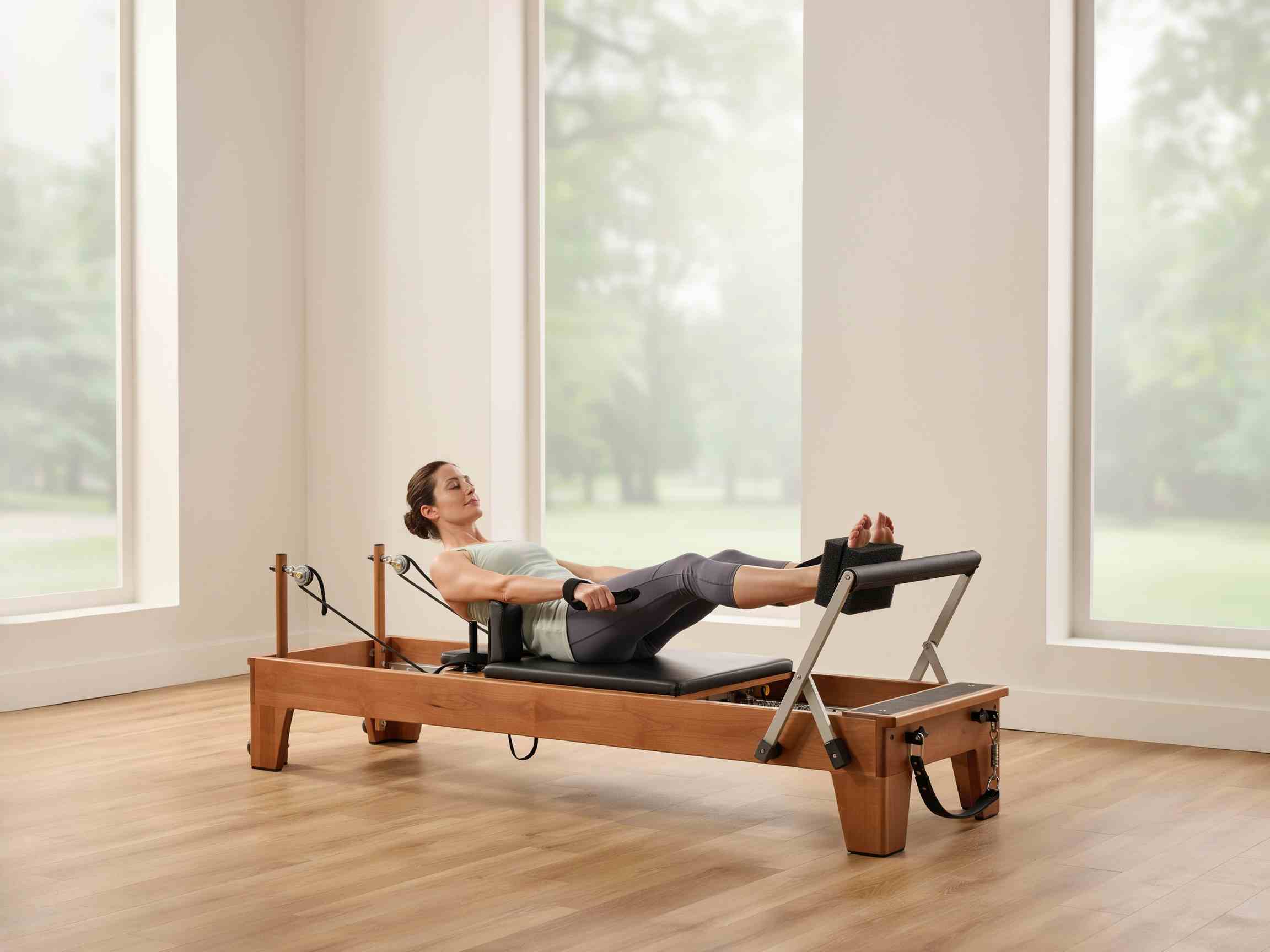
Reformer pilates for knee pain is a form of resistance training performed on a sliding carriage with adjustable springs, where most of the knee-focused work happens lying down or seated rather than standing. The core idea is to strengthen the quadriceps, hamstrings, glutes, and calf muscles that stabilize the knee joint, while removing the body-weight compression that standing exercise puts through the joint itself.
This matters because most knee pain is not a knee problem in isolation. It is usually a strength or alignment problem somewhere else in the leg that shows up as pain at the knee. Weak glutes let the knee drift inward during a step. Tight or underworked calves change how load travels up from the foot. A weak quad fails to control the kneecap's tracking through its groove. The reformer is built to isolate and retrain exactly these weaknesses, one spring setting at a time.
Why the Reformer Works Better Than Standing Exercise for a Sore Knee
The short answer is load control. A standing squat or lunge sends your full body weight through a bent knee with very little room to adjust the resistance mid-movement. A reformer lets an instructor dial that resistance down to almost nothing and increase it in small, exact increments as the knee tolerates more.
How Spring Resistance Controls the Load
Each spring on a reformer adds a fixed amount of resistance, and studios typically offer four to six springs that can be combined. For a painful knee, footwork usually starts on one or two light springs, which create just enough resistance to activate the quadriceps and hamstrings without forcing the joint through a hard end range. As strength returns, springs are added gradually. This is different from a gym leg press machine, where the smallest weight plate available is often still too heavy for an irritated joint on day one.
Why Horizontal Positions Change Everything
Most of the knee work in reformer pilates happens supine, meaning you are lying on your back on the carriage. In this position, gravity is not compressing the joint the way it does when you stand. Footwork, leg presses, and leg circles performed lying down load the quadriceps and hamstrings through a controlled range while keeping compressive force through the kneecap and joint surfaces low. That single positional difference is why physiotherapists frequently introduce reformer work earlier in a rehab timeline than they would introduce standing strength work.
What the Research Says About Pilates and Knee Osteoarthritis
Knee osteoarthritis is one of the most common reasons adults reduce their activity, and it is also one of the best-studied conditions in relation to pilates. A 2025 systematic review and meta-analysis published in the International Journal of Rheumatic Diseases pooled data from eleven randomized controlled trials involving 476 participants and found consistent improvement in pain and function scores among people doing pilates compared with those who received no structured exercise. A separate 2025 meta-analysis in Annals of Medicine, covering eight RCTs and 322 participants across India, Iran, Pakistan, Brazil, and Nigeria, reported a significant reduction in WOMAC scores, the standard clinical scale for osteoarthritis pain and stiffness, with no increase in adverse events across the pooled studies.
Two things stand out from this body of research. First, several of the included trials were conducted in Pakistan, which means the evidence base is not purely Western or drawn from a different population than the one reading this article. Second, none of the reviewed trials found pilates made knee pain worse when it was properly supervised and dosed. The caveat in nearly every paper is supervision. Unsupervised or poorly modified pilates carries the same risk any exercise carries when the wrong movement is loaded too early.
Which Knee Conditions Respond Well, and Which Need Caution First
Not every knee problem responds to reformer work the same way, and this is the part most generic articles skip entirely.
Conditions the Reformer Handles Well
Patellofemoral pain syndrome, sometimes called runner's knee or anterior knee pain, responds well because the reformer allows quad strengthening through a shortened, pain-free range before progressing to a fuller range. Mild to moderate knee osteoarthritis, generally grades one through three, responds well for the same reason the research above shows: low-impact, high-repetition strengthening reduces the load the joint has to absorb during daily movement. IT band-related lateral knee pain also responds well, though the effective exercises are less about the knee directly and more about strengthening the hip abductors that control how the IT band tracks over the outside of the knee.
When to Get Cleared Before You Start
A locked knee, a knee that gives way without warning, significant swelling that appeared suddenly, or pain following a specific twisting injury are all signs that need a doctor's assessment before any exercise program, reformer or otherwise. Post-surgical knees, including after ACL reconstruction or meniscus repair, can absolutely use reformer work later in rehab, but only once a surgeon or physiotherapist has given a specific clearance and range-of-motion guidance. Starting reformer footwork too early after surgery, before tissue has healed enough to tolerate load, is one of the more common ways people set their own recovery back. If you are in this category, bring your surgeon's clearance note to your first session so the instructor can build around it rather than guessing.
Reformer Exercises That Are Safe to Start With
For a first session with an irritated but not acutely injured knee, instructors typically build a sequence in this order:
Supine footwork on the platform, heels together, using one to two springs, focusing on a small, controlled range rather than full extension.
Supine footwork on the arch of the foot, same light spring setting, which shifts emphasis slightly toward the calf and reduces direct knee strain further.
Bent-knee bridging with the feet on the footbar, which strengthens the glutes and hamstrings without loading the front of the knee at all.
Seated footwork, which lets the instructor watch how your kneecap tracks in real time and correct alignment before adding resistance.
Side-lying leg series off the carriage, targeting hip abductors, which is the single most effective addition for anyone with IT band-related pain.
Gentle leg circles within a small, pain-free arc, increased gradually as tolerance improves.
What to avoid early on: deep lunges on the reformer, jackknife and other exercises that load a fully bent knee under body weight, kneeling directly on the carriage without padding, and any standing squat variation before the seated and supine work has been tolerated pain-free for at least a few sessions. A common mistake is progressing spring resistance too quickly because the exercise "feels easy." Reformer resistance should increase based on how the knee feels the next day, not how the set felt in the moment.
How Long Before You Feel a Difference
Most of the clinical trials cited above ran for six to twelve weeks, with sessions two to three times per week, and that timeline lines up with what shows up in practice. Expect the first two to three weeks to focus almost entirely on control and pain-free range rather than visible strength gains. Meaningful reduction in day-to-day pain, such as less discomfort on stairs or after sitting, typically shows up somewhere between weeks four and eight, provided sessions are consistent and resistance is progressed gradually rather than in large jumps.
Reformer Pilates vs Other Options for Knee Pain
None of these options are universally better. The right one depends on the cause and severity of your knee pain.
Physiotherapy alone is the right starting point if your pain followed a specific injury, if you have significant swelling, or if you are not yet sure what is causing the pain. A physiotherapist can diagnose the structural issue before any exercise program begins, and many will prescribe reformer-style movements as part of that plan once a diagnosis is clear.
A gym leg press is a reasonable option once a knee is well past the acute stage and tolerating moderate load, but it offers far less precision than a reformer. You cannot easily isolate one leg's tracking or adjust resistance in small enough increments for an irritated joint, which is why several of the studies above specifically used pilates rather than conventional resistance machines.
Walking alone helps general joint health and is rarely harmful, but it does not build the targeted quad, glute, and hip strength that actually protects the knee during higher-demand movements like stairs or uneven ground. It is a good complement to reformer work, not a substitute for it.
A knee brace manages symptoms during activity but does nothing to address the underlying weakness causing the pain. It has a place for specific activities or flare-ups, not as a long-term strategy on its own.
Mistakes People With Knee Pain Make in Class
The most common mistake is not telling the instructor about the knee pain at all, either from embarrassment or the assumption that a fitness class isn't the place for a medical conversation. The second most common mistake is pushing through sharp pain during an exercise, which is different from the mild muscular fatigue that is expected. A third mistake, common among people who feel good after a session, is doubling up on springs the following week instead of progressing by one increment at a time. None of these are complicated to fix, but all three show up repeatedly in early sessions with new clients who have joint pain.
What to Ask Before Booking a Class in Rawalpindi
Before booking a reformer pilates class for knee pain in Rawalpindi or anywhere else, ask whether the instructor has specific training in working with joint pain or rehab clients, not just a general pilates certification. Ask whether the first session includes a movement assessment before jumping into a standard class format. Ask how class sizes work, since a smaller group means the instructor can actually watch how your knee is tracking rather than running a fixed sequence for everyone at once. If you are working around a doctor's clearance, ask whether the studio is comfortable building around specific restrictions rather than a generic program.
Wellness Club Zone, in Bahria Town Phase 7, Rawalpindi, offers reformer pilates with instructor-guided sessions and small class sizes, which allows this kind of individual adjustment for clients dealing with knee pain, post-injury recovery, or general joint stiffness. A free trial class is a reasonable way to see how an instructor handles your specific situation before committing to a package. Bring any physiotherapy notes or doctor's guidance with you so the first session can be built around your actual knee rather than a default beginner routine.
Reformer pilates is not a guaranteed fix for every knee problem, and pricing, current class schedules, and instructor availability should always be confirmed directly with the studio before you book, since these details change over time. What the evidence and practice both support is that a properly supervised, gradually progressed reformer program is one of the more reliable low-impact ways to strengthen a painful knee without the joint stress that stops many people from exercising at all. If your knee has been holding you back, the next step is a real assessment, not another week of guessing.
FAQ
Is reformer pilates good for knee pain? Yes, for most non-acute knee conditions. Reformer pilates strengthens the quadriceps, hamstrings, and hip muscles that stabilize the knee, using adjustable spring resistance and mostly lying-down positions that reduce compressive load on the joint. Research on knee osteoarthritis specifically shows consistent pain and function improvements when sessions are supervised and progressed gradually.
What reformer exercises should I avoid with knee pain? Avoid deep lunges, jackknife, kneeling directly on the carriage without padding, and standing squat variations early on. These load a fully bent or weight-bearing knee before the joint has built enough control. Start with supine footwork, bridging, and seated footwork instead, and add standing or deep-flexion movements only once those feel pain-free.
Can reformer pilates help knee osteoarthritis? Yes. A 2025 meta-analysis in the International Journal of Rheumatic Diseases and a separate 2025 review in Annals of Medicine both found pilates significantly reduced WOMAC pain and stiffness scores in people with knee osteoarthritis, with no increase in adverse events across the pooled trials, several of which were conducted in Pakistan.
How is reformer pilates different from mat pilates for knee pain? The reformer's adjustable springs let an instructor set resistance in much smaller, more precise increments than mat pilates or body-weight exercises allow. This matters most in the early stages of knee pain, when even light resistance needs to be dialed in carefully to avoid aggravating the joint.
How many reformer pilates sessions before knee pain improves? Most supervised programs run two to three sessions per week for six to twelve weeks before showing meaningful pain reduction. The first two to three weeks usually focus on pain-free range and control rather than visible strength gains, so early sessions may not feel dramatically different.
Is it safe to do reformer pilates after knee surgery? Only with specific clearance from your surgeon or physiotherapist, along with clear range-of-motion guidance. Reformer work can be introduced earlier in a rehab timeline than standing exercise because of its low compressive load, but starting before tissue has healed enough is a common cause of setbacks after ACL or meniscus surgery.


