
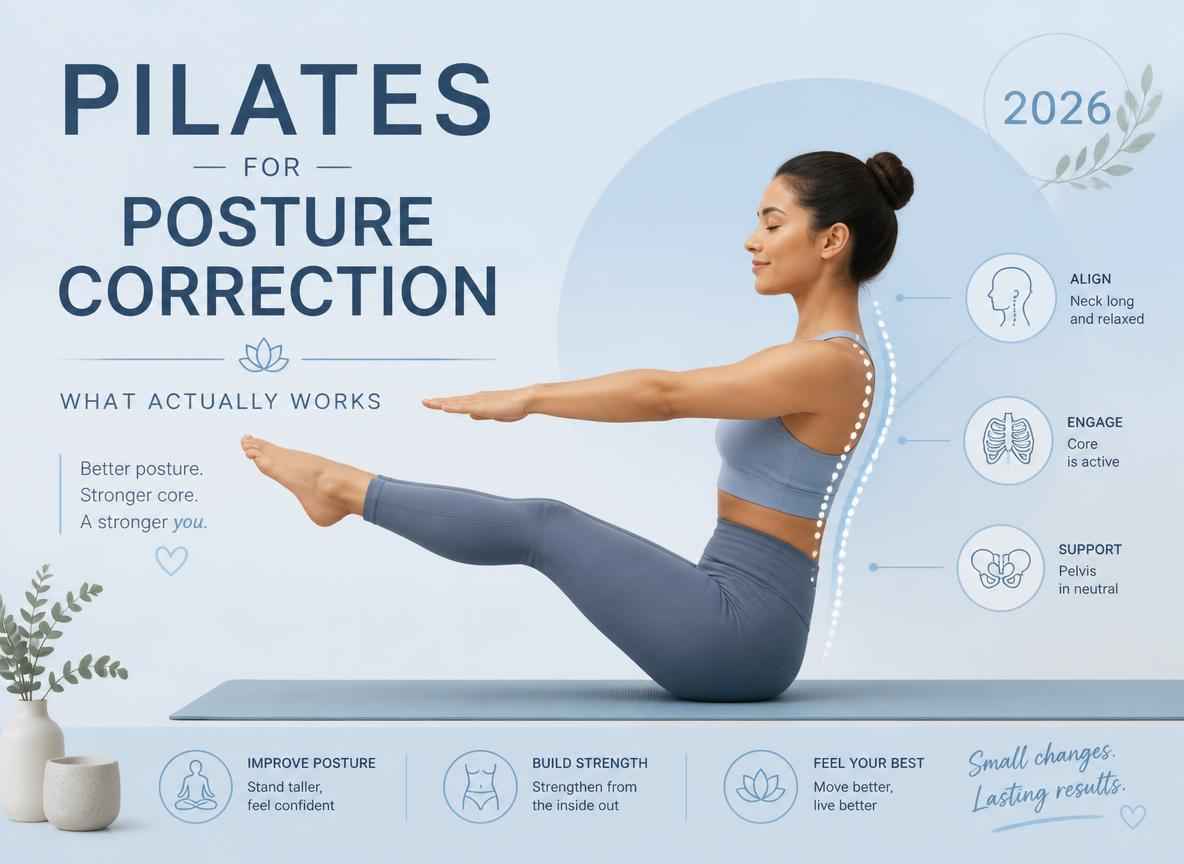
Pilates for Posture Correction: What Actually Works (2026)
Sit at a desk all day. Drive home. Sleep on a soft mattress. Do it for two years straight and your spine will tell you exactly what happened. Rounded shoulders, a forward-leaning head, persistent lower back tightness — these are not random problems. They are structural patterns built up over time. And the good news is they can be reversed, but not by stretching alone.
Pilates for posture correction works. It is not a trend. It is a training system specifically built to target the deep stabilizing muscles that hold your spine in place, muscles that most gym workouts completely bypass. This guide covers what that process actually looks like, which method is right for your situation, and what to realistically expect, whether you are dealing with mild stiffness or a full forward head posture that has been developing for a decade.
Why Your Posture Got Worse — And Why the Gym Did Not Fix It
Here is what most fitness advice misses: bad posture is a muscle imbalance problem, not a motivation problem.
When certain muscles shorten and tighten — typically the chest, hip flexors, and upper trapezius — the opposing muscles on the other side become long and weak. Your spine responds by shifting position to compensate. That shift becomes your default. And eventually, it starts hurting.
Standard gym training often makes this worse. Heavy pressing movements without enough rowing work tighten the chest further. Crunches strengthen the front of the core but don't address the posterior chain. Machines isolate muscles in fixed patterns, which does nothing to retrain how your body holds itself in space.
Pilates was designed by Joseph Pilates in the 1920s specifically around spinal alignment and deep core activation. The method has been developed continuously since then and is now widely used in physiotherapy and sports rehabilitation worldwide.
The key difference: pilates trains the muscles that control your posture as a system, not in isolation.
The Most Common Posture Problems Pilates Can Fix
Not all posture issues look the same, and a competent pilates instructor treats them differently. There are five common patterns worth knowing.
Forward head posture is when the head sits 2 to 4 cm in front of the shoulders. The deep neck flexors and upper trapezius are the primary muscles involved. Rounded shoulders — clinically called kyphosis — curve the upper back forward and involve the pectoral minor, rhomboids, and lower trapezius. Anterior pelvic tilt causes the lower back to arch and the stomach to protrude; the hip flexors, glutes, and transverse abdominis drive this pattern. Posterior pelvic tilt does the opposite — the lower back flattens and the pelvis tucks under — and typically involves the hamstrings and lumbar extensors. Finally, mild functional scoliosis presents as a lateral curve in the spine, with the spinal rotators, obliques, and quadratus lumborum all contributing.
Pilates addresses all five. But the approach differs. A person with anterior pelvic tilt needs different cueing and different exercises than someone with kyphosis — and mixing them up produces either no result or, occasionally, a flare-up.
This is why group class instruction quality matters enormously. A generic "posture class" is not the same as an instructor who assesses you first and adapts accordingly.
Reformer Pilates vs. Mat Pilates for Posture: Which One to Choose
This is the most common question people ask once they decide to start, and most content online gives a vague answer. Here is a direct one.
Reformer Pilates
The reformer is a spring-loaded carriage machine that provides variable resistance. For posture correction, this matters for one specific reason: it allows you to train spinal alignment while your body is supported. A person with significant muscle imbalances who tries to hold a correct posture position on a mat will often compensate by recruiting the wrong muscles. The reformer removes that compensation by giving the body feedback and support throughout the movement.
A 2023 study published in the Journal of Bodywork and Movement Therapies found that reformer-based pilates produced measurably greater improvements in thoracic kyphosis angle over a 10-week period compared to mat pilates alone. The researchers attributed this to the reformer's ability to target scapular stabilizers under load — muscles that are difficult to isolate without external resistance.
Reformer pilates at Wellness Club Zone in Bahria Town Phase 7 is instructor-led with separate booking slots, which means your sessions are corrective, not generic. That distinction is relevant for anyone dealing with an established postural pattern rather than mild stiffness.
Best for: Significant postural deviations, back pain, post-injury recovery, people who sit for 8+ hours a day, beginners who need structural support to learn correct movement.
Mat Pilates
Mat pilates uses bodyweight only. Without the spring resistance of the reformer, the body has to stabilize itself through each movement, which increases demand on core control. Done correctly, this is genuinely effective for posture maintenance and early-stage correction.
The challenge with mat pilates for posture correction is that movement quality depends heavily on body awareness. Without that foundation, beginners frequently load the wrong muscles. An instructor who catches those patterns in real time makes a significant difference.
Best for: People with mild postural habits, those in maintenance after reformer work, anyone who wants to supplement a reformer program at home, post-pregnancy recovery.
Which to start with
If your posture problem has symptoms — back pain, neck stiffness, headaches, shoulder tension — start with reformer pilates. If it's a mild habit you want to correct before it becomes a problem, either method works with consistent attendance and good instruction.
How Pilates Corrects Posture: The Actual Mechanism
Most people understand that pilates helps posture. Fewer understand why, and that understanding matters for setting realistic expectations.
Pilates for posture correction works through three mechanisms:
1. Deep Core Activation
The transverse abdominis, multifidus, and pelvic floor muscles are the body's internal stabilizing system. These are not the surface muscles you see in a mirror. They activate before visible movement begins, preparing the spine for load. In people with poor posture, these muscles are typically underactive — not weak in the traditional sense, but undertrained in their stabilizing role.
Pilates specifically trains them to fire in sequence, which gives the spine structural support it was not getting before.
2. Lengthening Shortened Muscles
Pilates movements involve eccentric loading — lengthening muscles under tension. This is more effective for releasing chronically tight muscles than passive stretching alone. The chest and hip flexors, which are typically shortened in desk-heavy lifestyles, get targeted directly.
3. Retraining Postural Habit Through Repetition
Posture is largely a neuromuscular habit. Your nervous system has learned to hold your body in a certain position because it has done it thousands of times. Pilates works by repeatedly training correct alignment in multiple positions — lying, seated, standing, in motion — until the new pattern starts to override the old one.
This is also why consistency matters more than intensity. Two to three sessions per week for eight to twelve weeks is the minimum effective dose for meaningful postural change.
What to Realistically Expect — And What Pilates Won't Do Alone
Bad posture took years to develop. It will not reverse in three sessions. Setting realistic expectations prevents people from quitting too early.
Here is a realistic timeline based on what practitioners observe across different client types.
In the first one to two weeks, expect increased body awareness, some muscle soreness, and a clearer understanding of your own pattern — not dramatic visible change. Weeks three to six bring more tangible results: reduced daily tension, less end-of-day back stiffness, and early improvements in resting posture. By weeks six to twelve, visible postural changes start to appear, pain frequency drops, and alignment in daily life begins to feel more natural. Beyond three to six months, structural correction of moderate imbalances becomes possible — but only if the practice continues consistently.
One limitation to be honest about: pilates alone will not resolve posture problems caused by structural skeletal issues, severe scoliosis, herniated discs, or untreated injuries. In those cases, a physiotherapy assessment should come first, and pilates becomes part of a broader rehab protocol — not the lead intervention.
If you sit at a desk for 8 to 10 hours a day and don't change that environment, pilates will slow the progression but may not fully reverse it. Ergonomic changes at your workstation are not optional in that scenario.
How to Know if Pilates Is Working for Your Posture
Progress is often not what people expect. Pain may increase slightly in the first two weeks as muscles that haven't worked properly are activated. This is normal and typically passes.
Here is a simple self-assessment checklist to track progress:
Standing against a wall, does the back of your head touch without straining?
Can you maintain a neutral spine in a seated position without active effort after a 30-minute session?
Has the frequency or severity of your neck and shoulder tension reduced?
Do you catch yourself rounding your shoulders and correct it without being prompted?
Is your resting standing position less fatiguing than it was a month ago?
If you're answering yes to two or more of these after six weeks of consistent sessions, you are on track. If none have shifted, your program may need reassessment — either the session frequency, the method, or the instruction quality.
An honest conversation with your instructor about what you're experiencing is always the right move at that point. At Wellness Club Zone, the instructors are available to adjust your program based on how your body is responding, not just follow a fixed class plan.
Pilates for Specific Posture Scenarios — Including the Ones Most Articles Skip
Desk workers in Rawalpindi
The 9-to-5 office pattern in Pakistani corporate culture — long hours, limited movement breaks, often paired with a commute in poor ergonomic conditions — creates a predictable pattern: anterior pelvic tilt combined with rounded upper back and forward head posture. This triple combination requires work on both the anterior and posterior chain simultaneously, which is exactly what reformer pilates sequences are built for.
Post-pregnancy posture
Pregnancy shifts the center of gravity forward, causing the lower back to arch excessively to compensate. After delivery, many women carry this pattern for months without addressing it. Mat pilates at a certified studio, starting with pelvic floor re-engagement before progressing to full core work, is appropriate here. The key is sequencing — going directly into challenging core exercises before the pelvic floor has recovered can cause pressure issues.
Teenagers and students
Posture problems in young people are increasingly driven by phone and laptop use. The earlier this is addressed, the easier it is to correct. In our observation of studio clients in this demographic, motivation tends to be the barrier more than physical capacity. Sessions that feel engaging and progressive keep this group consistent.
People who already exercise regularly
This is a gap almost no posture content addresses: active people who run, lift, or play sports often assume they're exempt from posture problems. They're not. Repetitive sport-specific patterns create their own imbalances. A runner with tight hip flexors and a weak posterior chain has postural dysfunction even with a high fitness level. Pilates addresses the imbalances that sport-specific training creates, not just replaces.
Starting Pilates for Posture Correction in Rawalpindi: A Practical Guide
If you're based in or around Rawalpindi, Bahria Town specifically, here is what the process looks like:
Book an initial session — not a drop-in class. A proper intake allows the instructor to assess your posture, identify your specific patterns, and recommend the right starting point.
Be honest about your history — back injuries, previous physiotherapy, pain points, and how long you've been dealing with the issue.
Commit to at least 8 weeks — two to three sessions per week. This is the minimum to observe meaningful change.
Don't skip the homework — a good instructor will give you one or two simple daily exercises to reinforce what you're doing in the studio. These take five minutes and significantly accelerate your progress.
Track how you feel off the mat — posture correction shows up most clearly in daily life, not in the session itself. Notice how your body feels after a day of sitting or driving.
Wellness Club Zone in Phase 7 offers both reformer pilates and mat pilates sessions with certified instructors. They also provide private and small-group slots, which matters if you want personalized correction rather than a general group class.
The Case for Starting Now Rather Than Later
Pakistan's fitness industry saw a notable shift between 2023 and 2026. Awareness of structured movement practices — pilates, yoga, functional training — moved from being a niche, upper-market preference to a recognized approach in urban centers including Rawalpindi and Islamabad. Studios offering reformer pilates specifically are still relatively limited in number, which means access to equipment and qualified instruction remains a consideration.
Waiting six months does not make posture problems easier to fix. Structural habits that have been in place for three years take longer to correct than ones that have been in place for one. The earlier you address it, the less correction work is required.
Summing Up: The Decision This Article Is Really About
If your posture is causing you daily discomfort — or even if it just looks wrong in photos and you know it is getting worse — pilates is one of the most evidence-supported methods for addressing it. Not because it is trendy. Because it directly targets the muscle systems responsible for how your body holds itself upright.
Between reformer and mat, start with reformer if your problem has progressed to pain or significant visual deviation. Start with mat if you're earlier in the curve and want to establish a foundation. In either case, instructor quality and session consistency matter more than which method you choose.
Wellness Club Zone offers a free trial class — that is a zero-commitment way to assess whether the approach, the environment, and the instruction quality are the right fit for you. Book one session. Your posture will not fix itself by reading about it.
The investment is not just in how you look. It is in how long your spine stays functional.
FAQ SECTION
Q1: How long does it take for pilates to correct posture?
Meaningful postural improvement typically takes six to twelve weeks of consistent pilates practice, at two to three sessions per week. The timeline depends on how long the postural pattern has been established and how significant the imbalance is. Mild habits can shift in four to six weeks. More established patterns — rounded shoulders that have been developing for five or more years — may take three to six months to see structural change. Consistency matters far more than session intensity.
Q2: Is reformer pilates better than mat pilates for posture correction?
For significant or painful postural issues, reformer pilates is generally more effective because the spring resistance allows you to train alignment while supported, which reduces compensation. Mat pilates is effective for mild correction and posture maintenance. Many people start with reformer pilates and add mat pilates practice at home once they have developed body awareness. For beginners with no prior pilates experience and existing back issues, the reformer is the safer and faster starting point.
Q3: Can pilates fix forward head posture?
Yes, pilates can improve forward head posture, but it requires consistent targeted work on the deep cervical flexors and upper back stabilizers. This is not addressed by generic core exercises — it requires specific exercises and qualified cueing. A 10-week reformer program targeting thoracic extension and scapular retraction has been shown to produce measurable changes in head position. Results are accelerated when combined with ergonomic adjustments at the workspace.
Q4: How often should I do pilates for posture correction?
Two to three sessions per week is the minimum effective frequency for posture correction. One session per week may maintain general fitness but is unlikely to produce significant structural change in established postural patterns. Daily short sessions of 15 to 20 minutes focused on specific exercises — provided by your instructor — can supplement studio sessions and significantly speed up the process.
Q5: Is pilates safe for people with back pain?
Pilates is widely used in physiotherapy for back pain rehabilitation and is generally safe when taught by a qualified instructor who knows your history. The key is informing your instructor of your specific diagnosis or pain pattern before starting. Certain exercises are modified or avoided depending on the type of back issue. Reformer pilates is often preferable for people with back pain because the spring support reduces spinal load. Anyone with an acute injury or recent diagnosis should get medical clearance first.
Q6: Can men benefit from pilates for posture correction?
Yes, and in many studio settings, men often see faster initial gains because they are starting from a lower baseline of body awareness and the neuromuscular improvements feel significant quickly. The posture problems that men face from desk work, driving, and gym training without adequate mobility work are the same ones pilates directly addresses. The exercises are not gender-specific, though a good instructor will account for typical male flexibility limitations when progressing the program.
Q7: What is the difference between pilates and yoga for posture?
Both improve posture, but through different mechanisms. Yoga primarily works through passive stretching, balance, and breath-linked movement. Pilates specifically targets the deep stabilizing muscles of the spine and pelvis with controlled resistance. For structural posture correction — changing how your body holds itself under neutral conditions — pilates is more direct. For stress reduction, flexibility, and a mindfulness component alongside postural work, yoga is valuable and the two complement each other well.
Q8: How do I know if my posture problem needs pilates or physiotherapy first?
If you have active, daily pain that is affecting your sleep, work, or movement, see a physiotherapist before starting pilates. They can diagnose the source of the pain and determine whether pilates is appropriate as a starting point or should follow manual therapy. If your situation is more about visible postural habits — rounded shoulders, forward head, lower back arch — without significant pain, you can start pilates directly. An intake assessment with a qualified instructor should surface any concerns at that stage.


