
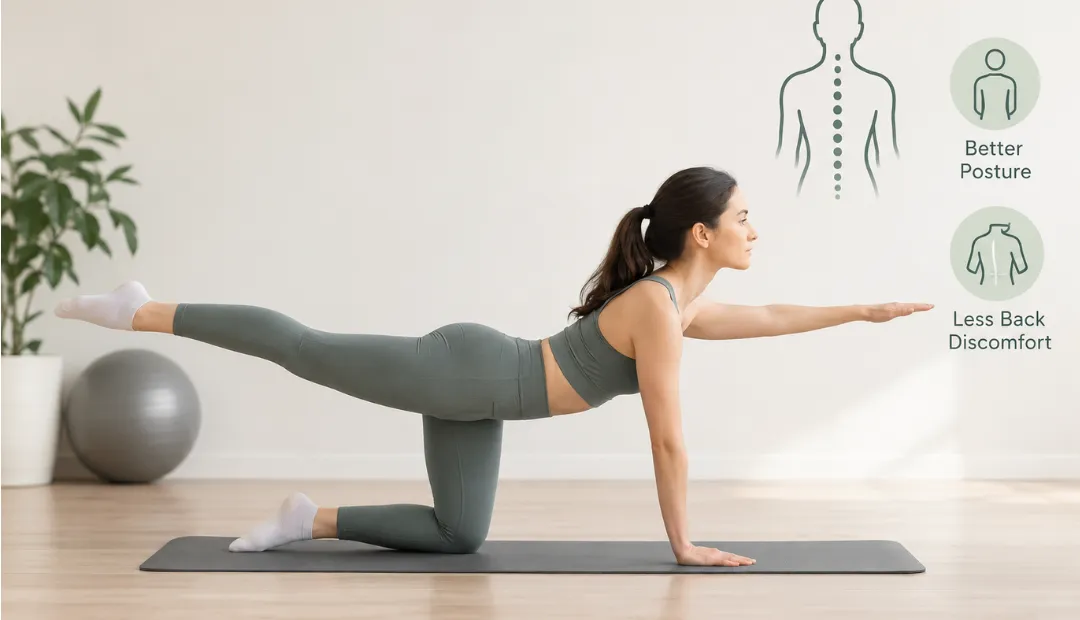
Pilates for Posture and Back Discomfort
Can Pilates Help Improve Posture and Reduce Back Discomfort?
Pilates can help improve posture, strengthen the muscles that support the body, and reduce some types of back discomfort. It focuses on controlled movements, breathing, flexibility, and body awareness. With regular practice, people may find it easier to maintain a comfortable posture while sitting, standing, and moving.
For people who spend long hours at a desk, use mobile phones frequently, or experience stiffness after sitting, Pilates may be a useful addition to their fitness routine. However, it is not a guaranteed treatment for back pain, and the right exercises depend on each person's needs.
How Does Pilates Help Improve Posture?
Pilates can support better posture by improving body awareness, muscle control, flexibility, and strength. These skills may help you maintain a more comfortable position during everyday activities.
Poor posture habits can develop when people spend long periods sitting, looking down at screens, or moving very little throughout the day. Pilates encourages controlled movements and helps participants become more aware of how they position their spine, shoulders, pelvis, and head.
Regular Pilates practice may help with:
Core strength: Exercises train the abdominal and trunk muscles that contribute to body control.
Spinal mobility: Gentle, controlled movements can help maintain comfortable movement through the spine.
Shoulder alignment: Certain exercises encourage better control of the shoulder blades and upper back.
Body awareness: Participants learn to recognise unnecessary tension and adjust their posture more comfortably.
Flexibility: Suitable stretching and movement exercises can help reduce feelings of stiffness.
Good posture does not mean keeping your back perfectly straight all day. Changing positions regularly and moving comfortably are also important.
Can Pilates Reduce Back Discomfort?
Pilates may help reduce some types of lower back discomfort by improving movement, strength, and physical function. Research suggests it can be more helpful than doing very little, although it has not consistently been shown to be better than other forms of exercise.
The NHS notes that activities such as Pilates, yoga, walking, and swimming may help ease back pain. Exercise should be appropriate for your symptoms and physical abilities.
Pilates may be useful for people who experience mild stiffness after sitting for long periods, reduced flexibility, or discomfort associated with inactivity. However, persistent or severe pain can have different causes and may require professional assessment.
For more information, read the NHS guidance on back pain.
Which Pilates Exercises May Help With Posture and Back Discomfort?
Exercises that focus on gentle spinal movement, controlled breathing, core coordination, and hip mobility may support better movement and posture. The most suitable exercises depend on your comfort level and any existing injuries or medical conditions.
Some exercises commonly used in Pilates include:
1. Pelvic Tilts
Pelvic tilts involve gently moving the pelvis while lying on your back. They help participants become more aware of pelvic movement and control.
2. Cat-Cow Movement
This movement involves gently rounding and extending the spine while on hands and knees. It encourages spinal mobility and controlled movement.
3. Glute Bridges
Glute bridges involve lifting the hips while lying on your back. When appropriate, they help train the gluteal muscles and the muscles involved in controlling the pelvis.
4. Dead Bug Variations
Modified dead bug exercises involve moving the arms or legs while maintaining comfortable trunk control. They can help develop coordination and core strength.
5. Gentle Hip Mobility Exercises
Controlled hip movements may help people who feel stiff after prolonged sitting. Improving comfortable hip movement can make everyday activities easier.
Important: These exercises are examples, not a personalised treatment plan. Stop any movement that increases your pain, and seek advice from a qualified healthcare professional if you have an injury or an ongoing back problem.
Mat Pilates vs Reformer Pilates for Posture
Both Mat Pilates and Reformer Pilates can support posture and movement control. The better option depends on your comfort, goals, experience, and the guidance available.
Feature | Mat Pilates | Reformer Pilates |
|---|---|---|
Equipment | Uses a mat and body weight | Uses a reformer machine with springs and a moving carriage |
Resistance | Mainly body weight and optional small equipment | Adjustable spring resistance |
Movement control | Focuses on controlled floor-based exercises | Allows a variety of supported and resisted movements |
Beginner suitability | Can be adapted to different fitness levels | Can also be adapted with instructor guidance |
Posture goals | Develops body awareness, strength, and flexibility | Develops body awareness, strength, and flexibility through machine-based exercises |
Neither option is automatically better for back discomfort. Exercise selection, correct technique, and individual needs matter more than choosing a particular format.
If you want to learn more, explore Wellness Club Zone for information about Pilates and wellness classes in Bahria Town Phase 7, Rawalpindi.
How Often Should You Practise Pilates for Better Posture?
Practising Pilates consistently can help develop strength, movement control, and body awareness over time. However, progress varies according to your starting fitness level, exercise selection, consistency, and individual needs.
Beginners can start with shorter sessions and gradually build up as their comfort and control improve. A qualified instructor can help you learn the correct technique and choose appropriate modifications.
You can also support your posture outside class by:
Taking regular movement breaks during long periods of sitting.
Adjusting your desk and screen to a comfortable height.
Walking regularly, according to your ability.
Avoiding staying in one position for too long.
Using comfortable positions rather than forcing yourself to maintain a rigid posture.
Remember that Pilates works best as part of an overall active lifestyle rather than as a replacement for medical care when it is needed.
When Should You Seek Professional Advice Before Starting Pilates?
If you have persistent, severe, or unexplained back pain, speak to a healthcare professional before starting a new exercise programme. An instructor can help with exercise modifications, but should not diagnose or treat an underlying medical condition.
Seek urgent medical attention if back pain is accompanied by new difficulty controlling your bladder or bowels, numbness around your genitals or buttocks, or new weakness or numbness in both legs. These symptoms can indicate a serious problem.
People recovering from injuries, managing an existing spinal condition, or experiencing pain that worsens with movement should seek individual guidance before exercising.
Start Your Pilates Journey at Wellness Club Zone
At Wellness Club Zone, we offer Pilates and other wellness-focused classes in Bahria Town Phase 7, Rawalpindi. Whether your goal is to improve flexibility, build strength, develop body awareness, or establish a consistent fitness routine, choosing exercises suited to your needs is an important first step.
Our studio offers Mat Pilates and personalised Reformer Pilates sessions, with options to suit different fitness goals.
If you are looking for a Pilates studio in Rawalpindi, contact Wellness Club Zone to learn more about our classes and find an option that suits your schedule and goals.
Frequently Asked Questions
1. Can Pilates correct poor posture?
Pilates may help improve posture by developing body awareness, strength, flexibility, and movement control. Results vary, and persistent posture concerns may require individual assessment.
2. Is Pilates good for lower back discomfort?
Pilates may help some people with lower back discomfort, particularly when exercises are selected for their abilities. It is not guaranteed to relieve pain and is not proven to be superior to every other form of exercise.
3. Is Mat Pilates or Reformer Pilates better for back discomfort?
Both can be adapted to different fitness levels. The best choice depends on your symptoms, goals, exercise experience, and the guidance of a qualified instructor or healthcare professional when necessary.
4. How long does it take to notice posture improvements with Pilates?
There is no fixed timeline. Some people notice improved movement awareness relatively early, while changes in strength, comfort, and exercise control may take longer. Results depend on consistency and individual circumstances.
5. Can beginners with back stiffness start Pilates?
Some beginners with mild stiffness may be able to start with gentle, modified exercises. Anyone with ongoing pain, a recent injury, or an existing medical condition should seek appropriate professional advice first.
Conclusion
Pilates can be a useful way to develop better movement habits, improve body awareness, and support the muscles involved in posture. It may also help reduce some types of back discomfort when the exercises are appropriate for the individual.
The key is to start at a suitable level, practise with good technique, and remain consistent. If back pain is persistent or worsening, seek professional advice rather than relying on exercise alone.
For Pilates classes in Bahria Town Phase 7, Rawalpindi, explore the services offered by Wellness Club Zone and choose a programme that matches your fitness goals.


