
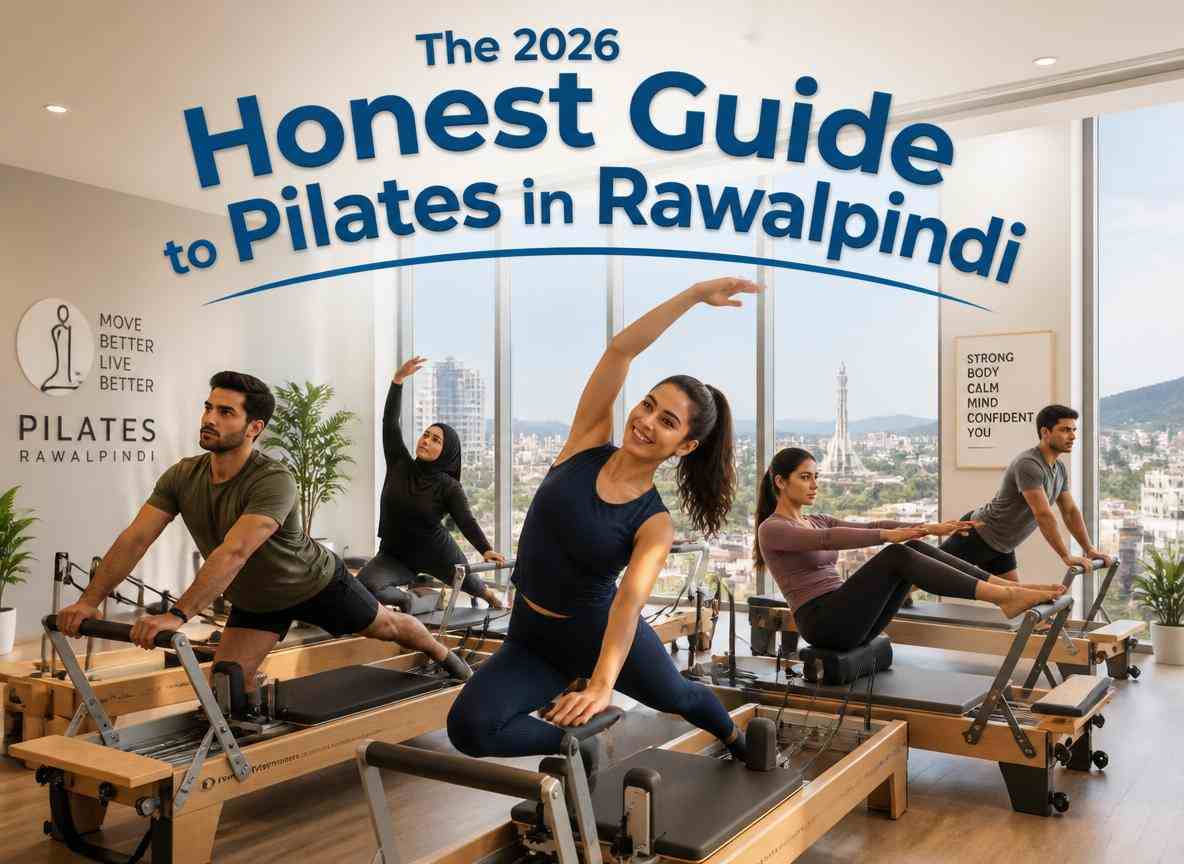
Pilates in Rawalpindi: The 2026 Honest Guide
You've seen it on social media. You've heard someone say it changed how they move, how they stand, how they feel after years of chronic back pain. Maybe a friend who just had a baby is doing it, or a colleague who used to swear by the gym has switched entirely. Whatever brought you here, the question underneath the search is usually the same: does Pilates actually work, and is it worth your time? The answer is yes, with conditions worth understanding before you walk into any studio. This guide covers what Pilates is, what the current research confirms it does, who gets the most from it, and how to start at Wellness Club Zone in Rawalpindi without wasting your first few months figuring out what nobody told you.
What Pilates Is — And What It Isn't
Pilates is a structured movement system built around core strength, spinal alignment, controlled breathing, and precise muscular engagement. Joseph Pilates developed the method in the early 20th century, originally calling it Contrology, and documented the foundational 34 exercises in his 1945 book Return to Life Through Contrology. The system was first used to rehabilitate injured soldiers and later adopted by dancers, athletes, and eventually the general public.
What makes Pilates distinct from generic floor exercise is the internal logic of the method. Every movement exists for a specific reason. The breathing pattern in each exercise either assists the movement or protects the spine under load. The sequence of exercises follows a deliberate progression, each one preparing the body for the next. You don't do Pilates and then happen to feel better. The method is designed around producing specific physical and neurological changes.
What Pilates is not: it is not yoga, not stretching, not a gentle warm-down routine, and not a beginner version of something more demanding. A correctly taught Pilates session is technically demanding, requires deep concentration, and consistently surprises people who arrive expecting something easy. Industry experts have a useful way of putting this. Vesna Jacob, a Pilates instructor with decades of practice, summed it up in a February 2026 interview with The Style List: "It's not about doing more; it's about doing better."
That principle separates Pilates from most of what happens in a conventional gym. Five reps with full muscular control, precise spinal alignment, and correct breath coordination produce more physical change than twenty reps done with momentum and compensation. That's not a philosophical position. It's what the research on neuromuscular activation consistently shows.
What the Research Actually Says About Pilates in 2026
The clinical evidence for Pilates has grown substantially in recent years, moving well beyond anecdotal endorsement into specific, measurable, peer-reviewed outcomes.
A March 2025 observational study published in Healthcare (MDPI), authored by Sara Guidotti and colleagues at the University of Parma, compared people practicing mat Pilates with non-active control groups and found significant decreases in anxiety scores, depression scores, and somatization, as well as measurable improvements in stress-related risk behaviors. The Pilates group attended one hour of mat Pilates per week for three months. The results were statistically significant across anxiety (p less than 0.001), depression (p less than 0.05), and somatization (p less than 0.01). These are not anecdotal improvements. They are measured changes on validated psychological assessment scales.
A 2024 systematic review published in BMC Sports Science, Medicine and Rehabilitation confirmed that Pilates consistently improves postural alignment and can correct structural imbalances including excessive thoracic kyphosis and anterior pelvic tilt. These conditions are not cosmetic problems. They are the underlying cause of the chronic upper back pain, neck tension, and lower back discomfort that affect the majority of people who spend large portions of their day seated at a desk.
A randomized controlled trial published on SpringerLink in 2025 found that reformer-based Pilates significantly improved pain levels, sleep quality, and psychological well-being in adults with chronic musculoskeletal pain. The control group showed no comparable improvements across the same period.
The Pilates and yoga studios market was valued at USD 142.30 billion in 2025 and is projected to grow at a CAGR of 14.5% from 2026 to 2034, according to Allied Market Research. The global Pilates market specifically was valued at USD 12.9 billion in 2026 and is expected to reach USD 22.6 billion by 2033, according to Future Data Stats. Asia-Pacific is cited as among the fastest-growing regions in both reports. Pakistan's fitness market, particularly in cities like Rawalpindi and Lahore, is part of that growth trajectory.
Jim Heidenreich, CEO of Merrithew, stated in the Pilates Journal's 2026 industry predictions report in May 2026: "Consumer demand for mindful movement, instructor-led experiences, and high-quality equipment continues to accelerate." Brent Anderson, founder of Polestar Pilates, was more direct: "All research today in fitness and rehabilitation shows that Pilates is in the top 3 if not number 1 movement modality."
Mat Pilates: The Foundation That Makes Everything Else Work
Mat Pilates is the practice of the Pilates method using only a floor mat and your own bodyweight. No springs, no reformer machine, no external resistance. It is the original form of the practice and remains the foundation upon which all other Pilates formats are built.
The 34 exercises Joseph Pilates sequenced for mat work are challenging precisely because there is no mechanical assistance. On the reformer, springs can support your movement through ranges your strength can't yet fully control. On the mat, every position is held and every movement generated entirely from within. This makes mat Pilates the most direct test of genuine body control and the most important foundation for someone beginning the method.
The Exercises That Build the Foundation
The Hundred is the standard opening exercise in mat Pilates and the one that establishes everything: the breath pattern, the core engagement, and the ability to sustain controlled muscular work simultaneously. Lying on your back, knees at 90 degrees, head and shoulders lifted, arms pumping in short pulses beside the body. Inhale for five pulses, exhale for five. Ten full breath cycles for one hundred total pulses. It sounds simple. For someone who has never done it with correct form, it is not.
The Roll-Up builds spinal articulation and abdominal strength simultaneously. Starting flat with arms reaching overhead, exhaling to curl the spine off the mat one vertebra at a time until reaching forward toward the feet, then reversing with the same control. The difference between a Roll-Up and a sit-up is the same as the difference between a scalpel and a hammer. One is precise and produces specific results. The other is blunt and relies on whatever muscles happen to be dominant.
Single Leg Stretch trains the relationship between hip movement and lumbar stability. The spine must remain completely fixed while the legs alternate, which demands exactly the kind of deep core engagement that mat Pilates is built around. Double Leg Stretch adds both arms to the challenge. Criss-Cross adds rotation. Each exercise builds directly on the coordination established in the one before it.
Side-lying exercises address the hip abductors, adductors, and lateral pelvic stabilizers that the supine sequence leaves untouched. These muscles are consistently weak in sedentary people and are directly connected to knee alignment, lower back stability, and walking gait. Their absence from most gym programs is one reason general gym training often fails to address the movement problems people actually live with.
What Mat Pilates Does That Gym Training Typically Misses
Conventional gym training builds the muscles you can see working. Pilates builds the muscles working underneath. The transverse abdominis, the multifidus, the deep hip rotators, and the pelvic floor muscles are not easily reached by deadlifts or crunches. They are reached by the specific neuromuscular demands of the Pilates method, specifically by the combination of breath control, spinal position, and movement precision that each exercise requires.
A 2025 narrative review published in Crimson Publishers, authored by Tiffany Field, summarized the consistent findings across multiple Pilates research studies: increased balance, flexibility, muscle strength, and general physical fitness, alongside decreased body weight and reduced pain across lower back, neck, and other chronic musculoskeletal conditions. Cognitive flexibility increased and quality of life improved. These are not narrow benefits affecting a specific population. They appear consistently across age groups, fitness levels, and health conditions.
Who Gets the Most From Pilates
People returning to exercise after pregnancy benefit disproportionately. Pilates is one of the most widely used post-natal rehabilitation methods because it directly addresses the deep core weakening and diastasis recti that pregnancy commonly produces. The low-impact nature, the focus on the pelvic floor, and the ability of a qualified instructor to modify every exercise for postpartum conditions make it suitable in a way that most other fitness formats are not. Medical clearance before returning to structured exercise is standard advice. Instructor disclosure of postpartum status before the first session is not optional — it is how the session is made safe.
Desk workers are one of the most responsive groups because Pilates directly targets the problems their daily life creates. Anterior pelvic tilt, thoracic kyphosis, shortened hip flexors, and weakened deep abdominals are not random misfortunes. They are the predictable physical consequence of sitting for hours at a screen, and Pilates addresses each of them systematically. The improvement in daily posture is often what other people notice before the person practicing Pilates notices it themselves.
Women over 40 have strong research backing specific to their demographic. The 2025 Guidotti study referenced above included participants across adult age ranges and showed consistent benefits in anxiety, depression, and stress-related risk behaviors from once-weekly mat Pilates. A long history of research on older women specifically shows improvements in bone density, balance, and fall prevention from regular Pilates practice. These are outcomes that general gym training rarely prioritizes and that matter enormously for long-term quality of life.
People managing chronic back pain have perhaps the clearest clinical evidence in their favor. The SpringerLink 2025 RCT on chronic musculoskeletal pain showed significant pain reduction alongside improvements in sleep and psychological well-being. Multiple systematic reviews across the last decade confirm this pattern. The mechanism is not mystery: Pilates strengthens the deep spinal stabilizers that are consistently underdeveloped in people with chronic back pain, and it does so without loading the spine in ways that aggravate existing injury.
One population that sometimes struggles initially is people expecting rapid visible body composition changes. Pilates does contribute to body composition improvement, and a meta-analysis from Guangzhou University of Chinese Medicine confirmed that practicing Pilates leads to significant decreases in body weight, BMI, and body fat percentage in overweight and obese participants. But the timeline is longer than a HIIT program and the mechanism is different. Pilates builds lean muscle and reduces cortisol-driven fat retention through consistent practice, not through high calorie burn per session. The physical change becomes visible between weeks four and eight. The internal changes in strength and movement quality show up before the external ones.
Pilates in Pakistan: Where It Stands in 2026
Pakistan's relationship with Pilates is developing rapidly but unevenly. Route2Pilates in Lahore, established in 2009, is the longest-standing dedicated studio in the country and remains a reference point for quality and instructor certification standards. The Pilates Lab in Karachi, founded by Saniya M Shaikh and certified through the Balanced Body system, brought reformer and apparatus Pilates into a formal studio environment in the country's largest city.
In Rawalpindi and Islamabad, the dedicated Pilates studio landscape is thinner. General gyms in the twin cities area list Pilates as a service but typically mean a mat class with an instructor who may or may not hold specific Pilates apparatus certification. The distinction matters because Pilates taught by someone with a general fitness qualification and Pilates taught by someone with recognized method-specific training produce measurably different outcomes for clients, particularly those dealing with injury, postural problems, or post-pregnancy conditions.
Wellness Club Zone in Bahria Town Phase 7 offers certified instructor-led Pilates classes, both mat and reformer, as core services in a dedicated studio environment in Rawalpindi. For women in the twin cities seeking a studio that treats Pilates as a serious practice rather than an add-on to a general gym menu, the practical options are limited. Wellness Club Zone is one of them.
What Separates a Good Pilates Class From a Mediocre One
The single most important variable in Pilates results is instructor quality. A good instructor watches how you move, identifies compensatory patterns, corrects them before they become habits, and progressions your program based on what your body can actually do rather than what a generic schedule says you should be doing in week three.
In observed practice across structured Pilates programs, the difference in client outcomes between instructors with deep method training and those with surface-level certification is significant. Beginners in classes without real-time correction often reinforce the same movement problems they came to fix. They complete sessions. They don't make progress.
Class size is the second variable. An instructor managing twelve people cannot watch any individual closely enough to catch the neck compensation in the Hundred, the hip rotation during Criss-Cross, or the breath holding that signals an exercise is too advanced. Small group classes of four to eight people are the threshold where individual attention becomes genuinely possible.
Third is environment. Not aesthetics. The quality of the mat, whether the floor is appropriate for movement, whether the temperature is comfortable, whether you feel safe and not self-conscious during a practice that requires vulnerability and concentration. For women in Pakistan specifically, a private studio environment where the class is women-only matters directly to how fully they can focus on the practice. Distraction and discomfort do not coexist well with Pilates.
How to Start at Wellness Club Zone, Rawalpindi
Wellness Club Zone in Bahria Town Phase 7, Rawalpindi offers mat and reformer Pilates classes in a certified, instructor-led studio format. The facility is structured for women seeking specialist fitness guidance in a private, professional environment that is not a general gym.
Before your first session, communicate everything relevant about your body: current injuries, chronic pain, post-pregnancy status, how long you've been sedentary, and what you've tried before. This isn't background information. It directly shapes how the instructor modifies your first session and what progressions make sense for your specific starting point.
Wear fitted clothing that allows the instructor to see your alignment. Bring water. Eat lightly before class. And arrive willing to be corrected. In Pilates, a correction is not a failure. It's the mechanism through which the method works.
As a long-cited Pilates principle holds: in ten sessions you feel the difference, in twenty you see it, and in thirty you have a different body. That progression is real and follows naturally from consistent practice under qualified guidance.
Book your free trial class at wellnessclubzone.com or call 0309 0780850.
The Common Mistakes That Delay Results
Attending inconsistently is the most significant. Two to three sessions per week is the minimum frequency where the method produces measurable adaptation. One session per week produces very slow progress. The nervous system needs repetition to embed new movement patterns, and Pilates is fundamentally about retraining movement patterns.
Moving too fast through exercises to complete the rep count is the most common form error observed in beginner classes. Pilates doesn't reward speed. The muscular demand comes from controlled movement through the full range, held with precision. Rushing produces the appearance of completing exercises while bypassing the muscular work that makes them effective.
Skipping the beginner sequence to start with intermediate exercises is a trap that home-based practice makes easier to fall into. Exercises like the Teaser or the Jackknife require levels of simultaneous core strength, spinal flexibility, and body awareness that take months of foundational work to build safely. Attempting them before that foundation exists doesn't make the practitioner more advanced. It makes them more likely to compensate, reinforce poor patterns, and eventually plateau or injure themselves.
Treating neck tension as normal during abdominal exercises is a mistake that an instructor catches immediately and a YouTube video cannot. If your neck is straining during the Hundred, your deep abdominals are not doing the work. The solution is a modification, not more effort applied in the wrong direction.
The Bottom Line
Pilates is one of the most research-supported, clinically validated movement methods available, and its results extend far beyond what its reputation suggests to people who've never done it properly. It improves core strength, corrects postural imbalances, reduces chronic pain, and produces measurable improvements in anxiety and depression scores, all from a low-impact practice with a minimal injury profile. The global market's rapid growth through 2025 and 2026 reflects not trend-chasing but a growing awareness of these outcomes among people who've tried conventional fitness approaches and found them incomplete.
In Rawalpindi, starting Pilates means finding a studio with qualified instructors and small enough class sizes to give you real attention. Wellness Club Zone in Bahria Town Phase 7 offers both, along with a free trial class so you can assess the environment before committing to anything. Visit wellnessclubzone.com or call 0309 0780850.
The method was built to last. So were the results.
FAQ SECTION
Q1: What is Pilates and how does it work? Pilates is a structured movement system focused on core strength, spinal alignment, breath coordination, and precise muscular control. It works by targeting the deep stabilizing muscles that conventional gym training rarely reaches, through a sequenced set of exercises designed to progressively build body control and postural integrity. The method was developed by Joseph Pilates in the early 20th century and is now backed by substantial clinical research.
Q2: Is Pilates good for back pain? Yes, and the evidence is specific. A 2025 randomized controlled trial published on SpringerLink found that Pilates significantly improved pain levels and psychological well-being in adults with chronic musculoskeletal pain. Multiple systematic reviews confirm that Pilates strengthens the deep spinal stabilizers that are consistently underdeveloped in chronic back pain sufferers. Tell your instructor about your back condition before the first session so exercises can be modified appropriately.
Q3: How is Pilates different from yoga? Pilates is a structured movement system with sequenced exercises, specific breathing patterns tied to each movement, and a central emphasis on core stability and spinal health. Yoga is a broader practice with spiritual, meditative, and physical dimensions that vary significantly by tradition. Both are low-impact and beneficial. They are not interchangeable. Pilates is more specifically targeted at postural correction, deep core strength, and rehabilitation than most yoga formats.
Q4: How many times per week should I do Pilates? Two to three times per week is the effective minimum. The method requires repetition to embed new movement patterns into the nervous system. One session per week produces slow, limited results. Consistent two-to-three-session practice for eight to twelve weeks is where measurable changes in core strength, posture, and pain reduction become consistent across clinical research populations.
Q5: Can beginners start Pilates with no prior fitness experience? Yes. Pilates is one of the most accessible entry points into structured fitness precisely because it doesn't require existing strength, flexibility, or cardiovascular fitness. Every exercise can be modified by a qualified instructor to match the practitioner's current ability level. The method meets you where you are and builds from there.
Q6: Does Pilates help with weight loss? Pilates contributes to body recomposition rather than rapid calorie burn. A meta-analysis from Guangzhou University of Chinese Medicine found significant decreases in body weight, BMI, and body fat percentage in overweight and obese participants who practiced Pilates consistently. The mechanism works through lean muscle development, reduced cortisol levels, and improved metabolic function rather than high-intensity calorie expenditure.
Q7: What is the difference between mat Pilates and reformer Pilates? Mat Pilates uses only a floor mat and bodyweight, requiring the practitioner to generate all control internally. Reformer Pilates uses a spring-resistance machine that can assist or resist movement, allowing for a wider range of exercises and the ability to support weaker movement patterns while building strength. Mat Pilates builds deeper self-reliance and body awareness. Reformer Pilates produces results faster for some populations, particularly those with injuries or limited starting strength.
Q8: Is Pilates safe during or after pregnancy? After pregnancy, Pilates is widely used for rehabilitation, specifically for addressing core weakness and diastasis recti (abdominal separation). Medical clearance from a doctor before returning to exercise is standard advice. Disclosure of postpartum status to your instructor before the first session is essential. Not all Pilates exercises are appropriate immediately postpartum, and a qualified instructor modifies accordingly.


