
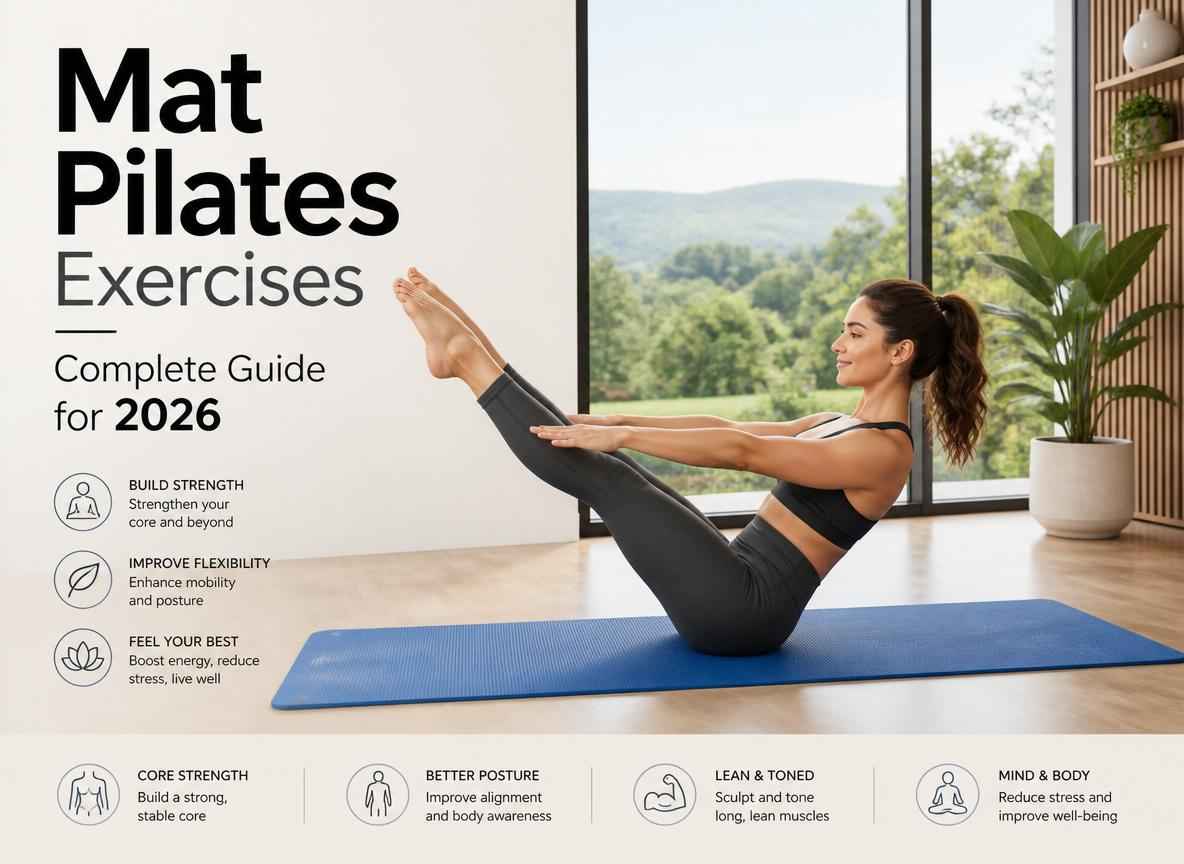
Mat Pilates Exercises: Complete Guide for 2026
Most people searching for mat Pilates exercises want one of two things: a list they can follow at home, or an honest answer to whether a floor-based class is worth their time. This guide gives you both. It covers the foundational and intermediate exercises, explains the logic that makes the method work, and tells you what realistic progress looks like for someone starting from scratch in Rawalpindi. No reformer required. No prior fitness background needed.
What Mat Pilates Actually Is
Mat Pilates is a bodyweight exercise system performed on a floor mat, built around the original method created by Joseph Pilates and documented in his 1945 book Return to Life Through Contrology. Every movement uses your own body as resistance. There is no machine, no spring system, and no external load.
The method is built on 34 sequenced exercises designed to progress logically from one to the next, each preparing the nervous system and musculature for what follows. This sequencing is not optional or decorative. It is the reason mat Pilates produces results that random floor exercise routines do not. When the Hundred comes before the Roll-Up, it's because the Hundred activates the breathing pattern and core engagement that the Roll-Up demands. Skip the sequence and you're doing floor exercises. Follow it and you're doing Pilates.
What mat Pilates is not: it is not yoga, not stretching, not a beginner version of something more serious, and definitely not a series of relaxed floor movements. The level of internal muscle engagement required in a correctly executed mat Pilates session surprises most first-time practitioners. That surprise is a reliable sign that the method is working.
The Six Principles That Govern Every Exercise
Understanding these principles before learning individual exercises separates people who see results from those who complete reps without benefit.
Concentration means your full attention belongs on the movement being performed. A mat Pilates session done while distracted produces a fraction of the benefit of the same session done with deliberate mental focus.
Control means no movement is generated by momentum, gravity, or compensation. Every transition and every rep is initiated by muscle engagement, held through muscle engagement, and reversed through muscle engagement.
Centering refers to the origin point of all movement in the Pilates method, which is the deep abdominal and pelvic floor muscles collectively known as the powerhouse. This region spans the area between the lower ribcage and the hips, front and back.
Precision means that correct form takes priority over completing the full range of motion. A half Roll-Up with a neutral spine and full abdominal engagement produces more benefit than a full sit-up done with momentum and a collapsing lower back.
Breath is not a background consideration. Each exercise has a specific inhale and exhale pattern that either assists the movement or protects the spine under load. Holding the breath during a Pilates exercise is a reliable indicator that the movement is too advanced for the current strength level.
Flow means that transitions between exercises should be smooth and intentional. In a well-run class at a studio like Wellness Club Zone in Rawalpindi, the session feels like a single continuous movement rather than a sequence of isolated drills.
Basic Mat Pilates Exercises: The Starting Foundation
These exercises form the core of any beginner mat Pilates program. They can all be modified by an instructor based on existing injuries, post-pregnancy status, or current mobility limitations.
The Hundred
Lie on your back with knees bent at 90 degrees in tabletop position. Lift your head and shoulders off the mat, extend arms long by your sides a few inches from the floor, and pump your arms up and down in short controlled pulses. Inhale through the nose for five pumps, exhale through the mouth for five pumps. Complete ten full breath cycles for 100 total pulses.
The Hundred activates the transverse abdominis, the deepest layer of the abdominal wall, and establishes the breath pattern used throughout the session. For beginners experiencing neck tension, lowering the head to the mat while keeping arms active is the correct modification. The benefit comes from the arm pump and the breath, not from how high the head lifts.
The Roll-Up
Lie flat with arms reaching overhead. Inhale to prepare, then exhale slowly as you curl the chin toward the chest, peel the spine off the mat one vertebra at a time, and reach forward toward your feet. Inhale at the top of the movement, then exhale to reverse, laying each vertebra back down in sequence.
The Roll-Up builds far more abdominal strength than a standard sit-up because it requires the spine to articulate through its full length rather than hinging at the hip flexors. Beginners commonly use momentum to get upright. An instructor will stop that pattern early and offer a modification, such as bent knees or hands behind thighs, that keeps the abdominals doing the work.
Single Leg Stretch
Curl head and shoulders off the mat with both knees pulled to the chest. Extend one leg at roughly 45 degrees while drawing the opposite knee in, placing the outside hand on the ankle and the inside hand on the knee. Switch legs in a controlled alternating motion, inhaling for two switches and exhaling for two.
This exercise trains the relationship between hip flexor movement and lumbar stability. The spine must remain completely still while the legs alternate. People with desk-based work patterns tend to feel this exercise in the neck initially, which signals an imbalance in how the upper abdominals are being recruited. An instructor catches this and adjusts the head position immediately.
The Bridge
Lie on your back with knees bent and feet flat on the floor hip-width apart. Inhale to prepare. On the exhale, press the lower back gently into the mat and peel the hips off the floor until the body forms a straight diagonal from shoulder to knee. Inhale at the top, then exhale to lower the spine back down one vertebra at a time.
The Bridge builds gluteal and hamstring strength while teaching controlled spinal articulation. It is one of the first exercises introduced to new clients at Wellness Club Zone because it requires no existing flexibility, is safe for most injury profiles, and produces a clear, felt result in the posterior chain after just a few repetitions.
Spine Stretch Forward
Sit upright with legs extended in front of you, slightly wider than hip-width apart. Flex the feet. Inhale to grow tall through the spine. Exhale to curve forward into a C-shape, pulling the abdominals in and up as the back rounds and arms reach toward the feet. Inhale to hold, exhale to sit back upright.
The purpose here is spinal decompression and active abdominal engagement in a seated position, not passive hamstring stretching. Each exhale should feel like the belly button is moving further away from the thighs. If the movement feels like simply bending forward, the core is not engaged correctly.
The Swan Prep
Lie face down with hands placed under the shoulders and legs together. Inhale to prepare. Exhale to press gently through the hands, lengthen the spine, and lift the chest off the mat. The movement should come from spinal extension, not from pushing up with the arms. Inhale at the top, exhale to lower back down with control.
Swan Prep builds the extensor muscles of the upper back and the deep spinal stabilizers that most floor-based exercise programs neglect entirely. For anyone spending significant time at a desk or screen, this is one of the highest-value exercises in the beginner repertoire.
Intermediate Mat Pilates Exercises: The Next Level
These exercises assume the beginner foundation is solid, which means breath and movement are coordinated, the spine can articulate through a controlled range, and the core activates without compensatory neck or shoulder tension. For most practitioners starting from scratch, this stage becomes accessible after four to eight weeks of consistent two-to-three sessions per week.
Criss-Cross
From the single leg stretch position, interlace fingers behind the head. As one knee pulls in, rotate the opposite shoulder toward it while extending the other leg long. Switch sides with full exhale on each rotation, maintaining stability through the pelvis.
Criss-Cross isolates the oblique muscles, which control rotational stability through the spine. These muscles are consistently underdeveloped in people who sit for extended periods, which makes this exercise both challenging and necessary for the majority of practitioners. The common error is pulling the head with the hands during the rotation. The rotation should come from the ribcage, not the neck.
Swimming
Lie face down with arms extended overhead and legs long. Lift the right arm and left leg simultaneously off the mat, then alternate in a flutter pattern. The spine stays long and the breathing remains continuous throughout the movement.
Swimming targets the posterior chain muscles that most of the supine Pilates exercises do not reach: the erector spinae, glutes, and upper back extensors. It directly addresses the forward-rounded posture created by prolonged screen use, which makes it relevant for most of the clients attending studio classes in Rawalpindi's professional community.
The Teaser
Lie on your back with legs together and arms reaching overhead. Simultaneously curl the upper body off the mat and lift the legs, arriving in a balanced V-shape with arms parallel to the legs. Hold briefly, then lower everything back to the mat with control.
The Teaser is the benchmark exercise in the Pilates mat repertoire. It requires simultaneous hip flexor strength, abdominal control, thoracic flexibility, and balance. Attempting it before the foundational exercises are properly established reinforces compensation patterns rather than correct ones. Most practitioners need three to five months of regular practice before the Teaser becomes accessible with clean form.
Side-Lying Leg Series
Lie on your side in a straight line from head to heel. Perform front and back swings with the top leg while keeping the pelvis completely still. Progress to inner thigh lifts with the lower leg, small circles with the top leg, and a bicycle pattern combining both legs.
The side-lying series addresses the hip abductors, adductors, and lateral pelvic stabilizers that almost every other exercise in the mat repertoire leaves untouched. Weakness in these muscles shows up as knee misalignment, lower back strain during walking, and instability during single-leg activities. In observed practice across structured Pilates programs in Pakistan, this series is where practitioners most commonly discover significant asymmetry between sides.
What the Research Says As of June 2026
The evidence base for mat Pilates has grown substantially through 2025 and into 2026, moving well beyond general fitness claims into specific, measurable outcomes.
A randomized controlled trial published in MDPI's sports science journal in April 2026 examined an 8-week mat Pilates intervention on older adults, running three 60-minute sessions per week. The study found significant improvements across core stability, pulmonary function, and cardiorespiratory fitness, specifically noting a mechanistic link between trunk stabilization and respiratory mechanics. This finding is particularly relevant for practitioners who notice their breathing becomes more controlled and efficient within the first few weeks of classes.
A separate 2026 study published in BMC Sports Science, Medicine and Rehabilitation at Springer Nature tracked 88 participants across a 6-week mat Pilates program. The Pilates group showed significant increases in body awareness scores and a large effect size in physical activity levels, meaning practitioners didn't just improve during sessions; they became more physically active in their daily lives outside of class. That secondary effect is rarely discussed in mainstream fitness content but is one of the more meaningful long-term outcomes of consistent mat Pilates practice.
Research published in PMC in 2025 confirmed that Pilates practice was associated with significant reductions in anxiety, depression, and stress scores compared to non-active control groups. This mental health benefit matters for the growing segment of Pakistani women who are drawn to Pilates specifically because the format is calm, controlled, and not characterized by the competitive or high-intensity environment of conventional gyms.
The global Pilates studios market, valued at approximately USD 614.68 billion in 2026 according to Market Reports World, reflects how broadly this shift has moved into mainstream fitness culture. The Asia-Pacific region, which includes South Asian markets like Pakistan, is among the fastest-growing areas for Pilates adoption as of mid-2026.
Who Gets the Most From Mat Pilates (And Who Should Know What to Expect)
Beginners and people returning to exercise after a gap tend to see the clearest early results. The method's structured progression means there's always a logical next step, and the improvement in core awareness within the first two weeks is typically the first tangible signal that something is working.
Women returning to exercise after pregnancy represent one of the most underserved audiences in Pakistan's fitness market. Mat Pilates is among the safest post-pregnancy reintroduction options when practiced under instructor guidance, but it requires the instructor to know about diastasis recti and modify accordingly. Not all mat exercises are appropriate immediately postpartum. The quality of instruction matters more than the exercise list.
Desk workers and professionals experience disproportionate benefit because mat Pilates directly addresses the specific physical problems created by prolonged sitting: anterior pelvic tilt, thoracic rounding, hip flexor tightness, and weakened deep abdominals. These are not aesthetic issues. They accumulate into chronic pain if left unaddressed, and mat Pilates is one of the most effective and accessible interventions for reversing them.
Women over 40 seeking low-impact, sustainable fitness should know that the evidence specifically supports this group. Multiple studies, including the 2026 MDPI trial, focus primarily on female participants in older age brackets and consistently document improvements in balance, functional mobility, and physical confidence, outcomes that general gym training rarely prioritizes.
People expecting fast, high-calorie-burn results need an honest expectation adjustment. Mat Pilates is not a high-intensity cardio method. Physical changes in body composition typically become visible between weeks four and eight of consistent practice. The postural improvement is usually what other people notice first. The internal changes in core strength and movement quality show up before the external ones.
What a Real Mat Pilates Class Looks Like at Wellness Club Zone
A guided mat Pilates class at Wellness Club Zone in Bahria Town Phase 7, Rawalpindi follows a structured format, not a drop-in floor session where clients interpret exercises without correction.
The class opens with a five-to-seven minute breathing and spinal warm-up sequence that establishes the connection between breath and core engagement before any demanding movement begins. This is not wasted time. The neuromuscular patterns established in this opening sequence directly influence how effectively every exercise that follows is performed.
The main sequence runs for approximately twenty-five to thirty minutes. It moves through supine positions, side-lying work, prone positions, and seated movements in the order the method prescribes. Each exercise prepares the body for the one that follows it.
The cool-down addresses spinal decompression and postural lengthening to release the accumulated muscular tension of the session and bring the nervous system back to a resting state.
Small-group class sizes mean the instructor watches form across the full group and offers real-time corrections specific to each body. This is where instructor-led mat Pilates produces fundamentally different results from home practice. An online video can demonstrate the movement. Only an instructor in the room with you can see that your right hip is twisting during the Teaser, or that your neck tension during the Hundred means you're gripping the superficial muscles instead of the deep ones.
If you're ready to see what a session feels like, book your free trial class at wellnessclubzone.com or call 0309 0780850.
A Realistic Four-Week Starting Framework
This describes what progress looks like in practice for someone attending two to three sessions per week with instructor guidance. It is not a guarantee or a marketing claim. It's an honest picture based on how the method works.
In the first week, the primary focus is breathing, neutral spine awareness, and the basic supine exercises: the Hundred with bent knees, the Bridge, Single Leg Stretch, and Spine Stretch Forward. Most beginners feel unfamiliar muscle fatigue in the deep abdominals and gluteals by day two. This is expected.
By the second week, with two to three sessions completed, breath and movement coordination improves noticeably. The Roll-Up begins to become accessible with modification. The neck tension common in week one starts to reduce as the upper abdominals take over the work the neck was compensating for.
In the third week, the beginner sequence begins to flow. Swimming is introduced. The posterior chain, which most people haven't consciously engaged in years, starts to feel activated during daily activities like sitting and standing.
By the fourth week, practitioners attending consistently report a noticeable shift in their posture both during exercise and outside of it. Criss-Cross and Bridge progressions are introduced. The core begins to engage automatically rather than requiring conscious initiation, which is the first reliable sign that the method has started to rewire movement patterns.
The Mistakes That Stall Progress Most Often
Pulling on the neck during abdominal exercises is the most common error in beginner mat Pilates. The hands behind the head provide support, not leverage. If the curl comes from yanking the chin toward the knees, the superficial neck muscles are doing the work the abdominals should be doing. Modify the range or lower the head until the abdominals can manage the position without assistance.
Holding the breath during effort is the body's way of signaling that the exercise is beyond the current strength level. Rather than pushing through, modify the position until controlled breathing can be maintained throughout.
Moving at the wrong tempo is a mistake that home practice reinforces and studio practice corrects. Faster is not harder in mat Pilates. Slower, with full muscular control through the entire range of motion, is significantly more demanding and significantly more beneficial than rushing through repetitions.
Irregular attendance produces minimal results. One session per week does not give the nervous system enough stimulus to adapt and retain new movement patterns. Two to three sessions per week is the minimum for genuine progress.
Skipping the warm-up sequence to get to "the real exercises" is a conceptual error. In the Pilates method, the warm-up sequence is the real exercises. The Hundred and the spinal warm-up are not preamble. They are the foundation that determines how effectively every exercise that follows is performed.
Starting Mat Pilates in Rawalpindi: Practical Considerations
You do not need to be flexible to start. You do not need prior fitness experience. You do not need specialist equipment. A Pilates mat, comfortable clothing that allows full movement, and willingness to receive and apply instructor feedback are the only genuine requirements.
What does matter is communicating your current physical status before the class begins. Existing injuries, any form of chronic pain, post-pregnancy status, and current activity level all inform how an instructor modifies exercises for you. At Wellness Club Zone, this intake process is standard practice. It's not an inconvenience to the class schedule. It's how the method is meant to be practiced.
Globally, Pilates continues its trajectory as one of the fastest-growing structured fitness disciplines. The Pilates studios market was valued at USD 614.68 billion in 2026 and is projected to grow at 7.4% annually through 2035, according to research published in February 2026. In Pakistan specifically, structured instructor-led fitness is gaining clear momentum, with women in Rawalpindi and Lahore increasingly seeking methods that produce lasting results without the high-impact intensity of conventional gym training. Mat Pilates meets that demand precisely because the barrier to starting is low and the depth of the practice, once you're inside it, is substantial.
The session you attend tomorrow will tell you more about where your body actually is than any article can. That's how Pilates works. It meets you where you are.
The Bottom Line
Mat Pilates exercises are among the most thoroughly validated forms of structured movement available today. The method works because it is a system with internal logic, not a random collection of floor movements. Results compound with consistency, and the benefits extend well beyond what most people initially expect: posture, pain reduction, improved breathing, mental clarity, and long-term physical resilience that holds across decades.
Wellness Club Zone in Bahria Town Phase 7, Rawalpindi offers certified, instructor-led mat Pilates classes in a structured, private environment built for real outcomes. Book your free trial class at wellnessclubzone.com or call 0309 0780850.
Strong bodies aren't built by knowing which exercises exist. They're built by doing them correctly, consistently, under guidance that holds the standard.
FAQ SECTION
Q1: What are the best mat Pilates exercises for absolute beginners? The four exercises that form the most effective beginner foundation are the Hundred with bent knees, the Bridge, Single Leg Stretch, and Spine Stretch Forward. Together they address core activation, spinal articulation, hip stability, and seated mobility without requiring prior strength or flexibility. Most certified instructors build the first two to three weeks of a beginner program around these four movements before adding anything else.
Q2: How soon do you see results from mat Pilates exercises? Most practitioners notice improved core awareness and better posture within two to three weeks of attending two to three sessions per week. Visible physical changes in abdominal tone and body alignment typically become apparent between weeks four and eight. The timeline depends on consistency, starting fitness level, and whether practice is instructor-guided or self-directed. Instructor-guided practice produces faster and more accurate results.
Q3: Can mat Pilates exercises be done at home without a teacher? They can, but the outcomes are less effective and the risk of reinforcing poor movement habits is real. The method depends on precise internal cues that are difficult to self-assess without feedback. Home practice works well as a supplement to studio sessions once foundational patterns are established. For the first two to three months, instructor-led practice is strongly recommended.
Q4: Is mat Pilates good for lower back pain? Yes, with appropriate exercise modifications. Multiple peer-reviewed studies confirm that mat Pilates strengthens the deep stabilizing muscles of the lumbar spine and reduces chronic lower back pain. A 2026 pilot randomized controlled trial published in PMC specifically documented significant improvements in disability scores and pain reduction in women with chronic nonspecific lower back pain following a structured mat Pilates core exercise program. Always inform your instructor about any back condition before the session.
Q5: What is the difference between mat Pilates and regular floor exercises? Mat Pilates follows Joseph Pilates' original sequenced system with specific breathing patterns, targeted deep muscle engagement, and logical progression between movements. Standard floor exercises like crunches typically isolate surface muscles through repetition without sequence logic or breath coordination. Mat Pilates builds the transverse abdominis and multifidus, the deep spinal stabilizers, rather than the surface abdominal muscles most people default to.
Q6: How many times a week should I attend mat Pilates classes? Two to three sessions per week is the optimal frequency for beginners. This provides enough neural and muscular stimulus for the body to adapt while allowing adequate recovery between sessions. Joseph Pilates recommended consistent regular practice over infrequent intense sessions. One session per week will produce limited progress. Three sessions per week with a rest day between each produces the clearest early results.
Q7: Are mat Pilates exercises safe during post-pregnancy recovery? Yes, with qualified instructor guidance and medical clearance. Mat Pilates is widely used in post-pregnancy recovery because of its low-impact nature and its emphasis on deep core rehabilitation. However, specific exercises must be modified or temporarily avoided if diastasis recti, the common postpartum abdominal separation, is present. An informed instructor screens for this and adjusts the program accordingly. Clearance from a doctor before returning to structured exercise is advisable.


