
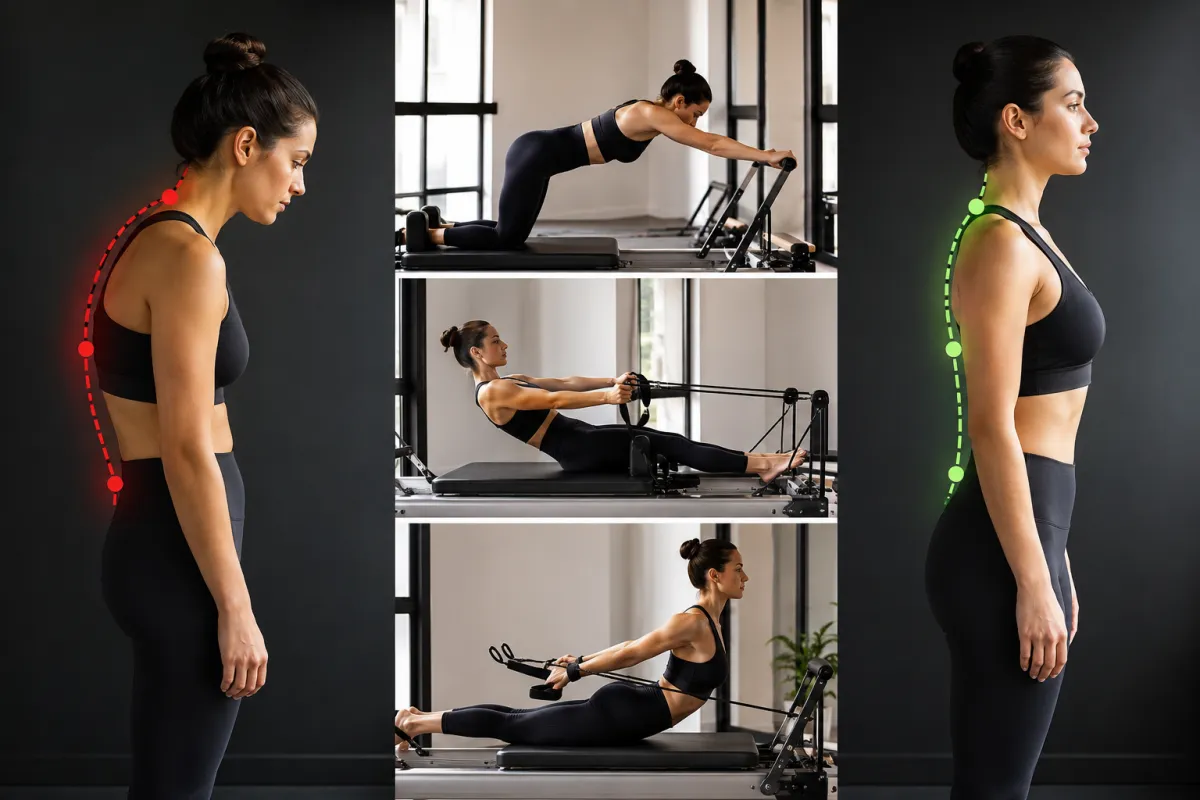
How Reformer Pilates Fixes Poor Posture (Science-Backed)
Poor posture from a desk job does not fix itself but Reformer Pilates addresses it at the root. Here is exactly what happens in your body, and why it works.
If you spend most of your day sitting at a desk or on your phone, or driving you are almost certainly developing postural problems. This is not a matter of willpower or laziness. It is a straightforward mechanical consequence of holding the same position for hours every day: certain muscles shorten and tighten, others lengthen and weaken, and the body gradually settles into a dysfunctional resting posture that becomes increasingly difficult to override.
The good news is that this is reversible. Reformer Pilates is one of the most effective tools for correcting poor posture not through reminders to sit up straight, but by systematically rebuilding the muscular balance that good posture depends on. This article explains exactly how.
What Poor Posture Actually Does to Your Body
Poor posture is not just an aesthetic issue. It creates a cascade of physical problems that, left unaddressed, become increasingly difficult to manage.
Forward Head Posture
For every inch the head moves forward of its neutral position, the effective load on the cervical spine roughly doubles. This creates chronic neck and upper back tension, headaches, and in severe cases, nerve compression.
Rounded Shoulders
The chest muscles tighten and the upper back muscles lengthen and weaken. This reduces shoulder mobility, compresses the thoracic spine, and restricts breathing capacity all of which worsen over time.
Weak Deep Core
Sitting deactivates the deep core stabilizers. Without this support, the lower back overworks to compensate, leading to the chronic lower back pain that affects the majority of desk workers after several years.
Tight Hip Flexors
Prolonged sitting shortens the hip flexors and tilts the pelvis forward an anterior pelvic tilt which compresses the lumbar spine and further weakens the glutes and core, creating a self-reinforcing cycle of dysfunction.
These four patterns typically appear together and reinforce each other. Addressing only one for example, doing core exercises while ignoring the hip flexors or upper back produces limited results. The reason Reformer Pilates is so effective for posture correction is that it works all of these simultaneously in every session.
The Science: Why Reformer Pilates Works for Posture
Multiple peer-reviewed studies have examined the effect of Pilates on postural alignment, back pain, and muscular imbalance. A consistent finding is that regular Pilates practice significantly improves spinal alignment, reduces chronic back pain, and strengthens the postural muscles of the trunk with effects that are maintained over time with continued practice.
The reason Reformer Pilates is particularly effective more so than mat Pilates alone is that the spring resistance allows the postural muscles to be loaded and strengthened in positions that would be impossible to maintain on a floor mat. The machine also provides biofeedback: when your alignment is off during an exercise on the Reformer, you feel it immediately in how the carriage moves, which trains proprioception (body awareness) far more rapidly than mat work.
Specifically, Reformer Pilates activates and strengthens the muscles that research identifies as critical for healthy posture: the deep neck flexors, rhomboids, lower trapezius, deep multifidus, and transversus abdominis all of which are chronically underactive in people with desk-based posture problems.
How Reformer Pilates Corrects Each Postural Problem?
1. Reactivating the Deep Core
Every Reformer exercise begins with core engagement specifically the transversus abdominis and multifidus, which are the muscles that stabilize the lumbar spine. Before strengthening the postural muscles of the upper body, you need a stable base in the trunk. Reformer Pilates builds this base systematically from the first session, which is why members typically notice lower back pain reducing before any other postural change becomes visible.
2. Opening the Chest and Shoulders
Exercises on the Reformer particularly those using the straps in a supine position stretch the pectorals and anterior deltoids that tighten from prolonged sitting, while simultaneously activating the rhomboids and lower trapezius that become inhibited. This combination directly reverses the rounded-shoulder pattern and restores the natural position of the shoulder blades on the ribcage. Most members notice a change in shoulder position within four to six weeks.
3. Lengthening the Hip Flexors
The kneeling and lunge-based exercises on the Reformer create a deep, active stretch of the hip flexors in a way that static stretching alone cannot replicate. Because the stretch is loaded you are working against spring resistance while lengthening the muscle the effect on hip flexor length is more lasting than passive flexibility work. Correcting this pattern also reduces the anterior pelvic tilt, which simultaneously takes pressure off the lumbar spine.
4. Restoring Cervical Spine Alignment
Forward head posture is addressed through exercises that train the deep neck flexors small muscles that are almost impossible to isolate and strengthen through conventional exercise. The Reformer's position options, combined with your instructor's guidance on head and neck positioning throughout every exercise, progressively rebuild the strength and awareness needed to hold the head in its correct position without conscious effort.
5. Training the Body to Hold Good Posture Automatically
The most important mechanism is proprioceptive training teaching the nervous system what correct alignment feels like so that good posture becomes the body's default rather than a conscious effort. The Reformer machine provides immediate sensory feedback during every movement. Over weeks of consistent training, the nervous system recalibrates so that correct alignment feels natural, not forced.
What to Expect Week by Week?
Timeframe
What Members Typically Notice
Weeks 1–2
Reduced lower back tension after sessions. Better awareness of posture during daily activities. Mild muscle soreness in areas that have been dormant.
Weeks 3–4
Reduction in chronic neck and shoulder tightness. Sitting for long periods becomes noticeably more comfortable. Visible improvement in how you stand at rest.
Weeks 6–8
Significant back pain relief in most members. Colleagues and family often start commenting on posture changes. Breathing feels fuller and easier.
Months 3–6
Good posture becomes the default rather than a conscious effort. Energy levels improve due to reduced muscular strain throughout the day. Most members describe this phase as transformative.
Results require consistency. Two to three sessions per week produces these outcomes reliably. One session a week will produce some benefit, but the timeline is significantly longer. Our Reformer Pilates classes in Rawalpindi are structured to fit around working schedules morning, afternoon, and evening slots are available.
Specifically for Desk Workers in Rawalpindi
The posture patterns described in this article are particularly prevalent among professionals in Rawalpindi who work in corporate, government, or technology roles long hours, often at poorly configured desks, with insufficient movement breaks. The problem is compounded by long commutes and the additional screen time that many people accumulate outside work hours.
The result is a level of postural dysfunction that, by the time people reach their late twenties and thirties, has become a genuine source of daily pain and reduced quality of life. Reformer Pilates is not a short-term fix for this it is a sustainable, evidence-based correction. Members who attend our Wellness Club Zone classes consistently describe the improvement in their working day as one of the most meaningful outcomes: less pain, more energy, better concentration.
Pairing Reformer Pilates with our Yoga classes can further accelerate flexibility gains, while Functional Strength Training builds the broader muscular endurance that supports good posture across long working days.
Posture correction is not vanity. Poor spinal alignment reduces lung capacity, affects digestion, compresses nerves, and creates chronic pain patterns that accumulate over years. Addressing it is one of the most practical investments in long-term health you can make and in Rawalpindi, it is now straightforwardly accessible.
Frequently Asked Questions
How long does it take to fix posture with Reformer Pilates?
Most members notice meaningful postural changes within four to six weeks of attending two to three sessions per week. Visible changes that others notice tend to appear around the six to eight week mark. Full correction of long-standing postural patterns typically takes three to six months of consistent training.
Is Reformer Pilates better than physiotherapy for posture?
They serve different purposes. Physiotherapy is appropriate when there is an acute injury or a specific structural problem that needs clinical assessment and treatment. Reformer Pilates is a preventive and corrective exercise method that is highly effective for postural dysfunction in the absence of acute injury. Many physiotherapists in Pakistan refer patients to Pilates specifically after acute treatment is complete.
Can Reformer Pilates help with a slipped or herniated disc?
Reformer Pilates can be beneficial for people with disc issues, but it must be approached carefully and with your doctor's clearance. Not all exercises are appropriate. Our instructors at Wellness Club Zone are experienced in modifying sessions for members with disc-related conditions, and we always ask for medical history before designing your programme.
Do I need to stop sitting at a desk to see results?
No though improving your workstation setup and taking movement breaks will accelerate results. Reformer Pilates is specifically designed to counteract the effects of prolonged sitting. Members see significant improvement without changing their working conditions, though the improvements are faster when desk habits are also addressed.


