
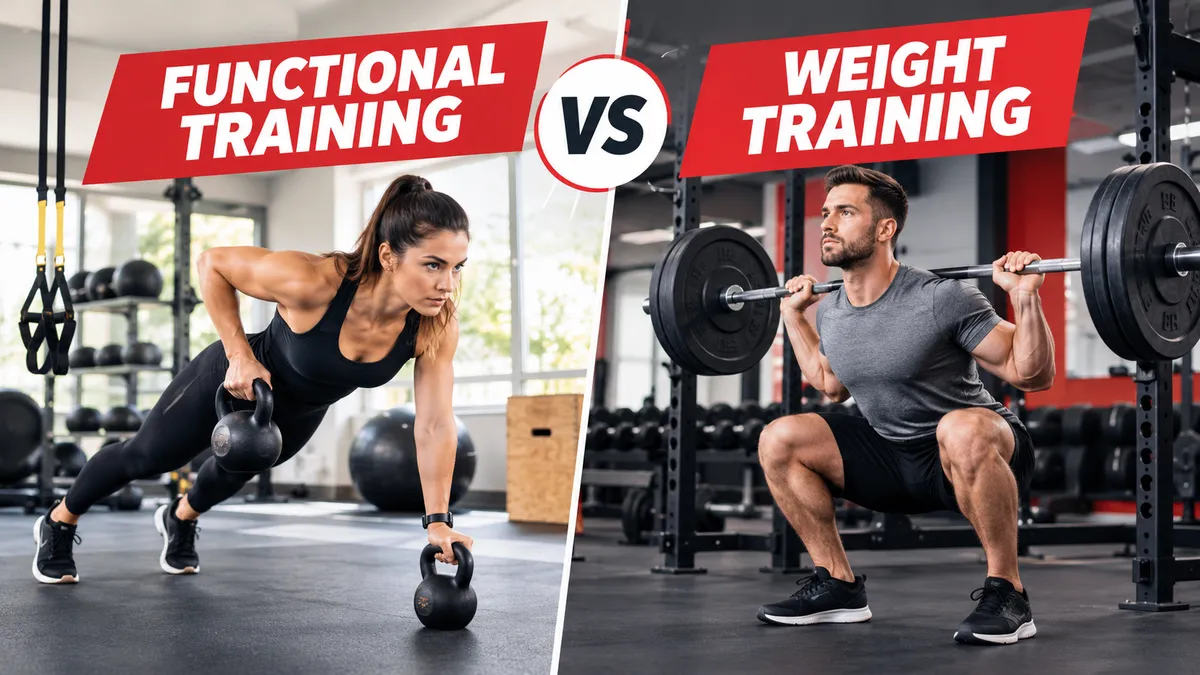
New Blog PoFunctional Training vs Weight Training: Which Is Better?st
Functional Training vs Weight Training: Which Builds a Better Body?
Walk into any gym today and you will see two very different tribes. On one side are the lifters, chalk on their hands, loading plates onto barbells and chasing a new personal best. On the other are the movers, swinging kettlebells, dragging sleds, balancing on one leg and flowing through patterns that look more like a playground than a workout. Both groups swear by their approach, and both are partly right.
So which one should you choose? The honest answer is that it depends on your goals, your body, your lifestyle and even your stage of life. In this guide, we break down functional training and weight training side by side, so you can decide what belongs in your routine and how to combine the two for the best results. If you are building a wider healthy lifestyle alongside your workouts, the resources at Wellness Club Zone are a useful companion as you go.
What Is Functional Training?
Functional training is exercise designed to improve how your body performs in real life. Instead of isolating a single muscle, it trains movement patterns: pushing, pulling, squatting, hinging, lunging, rotating and carrying. These are the same patterns you use when you pick up a child, lift a suitcase into an overhead bin, climb stairs or recover your balance on an icy sidewalk.
Typical functional exercises include:
Goblet squats and lunges
Kettlebell swings and carries
Push-ups and inverted rows
Medicine ball throws and rotational chops
Step-ups and single-leg Romanian deadlifts
Sled pushes and farmer's walks
Balance and stability drills
The defining feature is that these movements usually involve multiple joints and several muscle groups working together, often while your core stabilizes the whole system. Equipment is minimal and flexible: bodyweight, resistance bands, kettlebells, medicine balls, suspension trainers and sandbags are all common.
The goal is not simply to look strong but to be capable. That emphasis on usefulness is why functional training has become popular with older adults, desk workers, athletes in rehabilitation and anyone who wants a body that moves well.
What Is Weight Training?
Weight training, also called resistance training or strength training, is the practice of lifting progressively heavier loads to make muscles stronger and larger. It is built on a simple principle called progressive overload: if you gradually ask your muscles to handle more weight, more volume or more difficulty over time, they adapt by getting stronger.
Weight training includes both free weights and machines:
Barbell squats, deadlifts, bench presses and overhead presses
Dumbbell rows, curls and shoulder presses
Cable machine exercises
Leg presses, lat pulldowns and chest flyes
Some lifts are compound movements that involve many muscles, like the squat and deadlift. Others are isolation exercises that target one muscle, like the biceps curl or leg extension. Programs are usually organized by sets, repetitions and load, with clear numbers you can track and improve week after week.
That measurable progress is one of weight training's biggest attractions. You can see exactly how much stronger you are getting, which makes it highly motivating for many people.
Functional Training vs Weight Training: The Key Differences
The two styles overlap more than most people realize, since a barbell squat is arguably functional and a heavy kettlebell carry is certainly weight training. Still, their emphases differ in meaningful ways.
Primary Goal
Functional training aims to improve movement quality, coordination, balance and everyday performance. Weight training aims to maximize strength and muscle size, usually through heavier loads and more focused volume.
Movement Style
Functional workouts favor free, multi-planar movement, meaning you move forward and back, side to side and with rotation. Traditional weight training often moves in a controlled single plane, especially on machines, where the path of the weight is fixed.
Load and Intensity
Weight training can push loads far heavier than functional training typically does. A trained lifter may squat well over their body weight, something that is difficult to replicate with kettlebells or bodyweight alone. Functional training usually uses moderate loads, with intensity coming from complexity, instability, speed or conditioning demands.
Muscle Growth
If your priority is maximum muscle size, weight training has the edge. Hypertrophy responds well to heavy, progressive, well-structured loading and to isolating muscles that lag behind. Functional training can build muscle, particularly in beginners, but it is rarely the most efficient tool for it.
Core and Stability
Functional training places heavy demands on the core and stabilizing muscles because many exercises are unilateral or unstable. Machine-based weight training, by contrast, supports your body and reduces the stabilizer workload, although free-weight lifts like squats and deadlifts still train the core impressively.
Tracking Progress
Weight training offers clear metrics: pounds lifted, reps completed, personal records. Functional progress is often subtler: better balance, smoother movement, less stiffness, easier daily tasks. Both are valid, but the first is easier to quantify.
The Benefits of Functional Training
Better everyday performance. Because the exercises mimic real-life movement, strength carries over naturally to daily tasks. Carrying groceries, gardening, playing with your kids and climbing stairs all feel easier.
Improved balance and coordination. Single-leg work, rotational drills and unstable surfaces teach your nervous system to coordinate muscles quickly. This is especially valuable as we age, since balance is a major factor in preventing falls.
Stronger core. A functional program trains the trunk as a stabilizer rather than only through crunches, building a core that protects your spine during real movement.
Joint-friendly movement. Moderate loads and a focus on proper mechanics can make functional training gentler on joints for many people, and it encourages mobility through a full range of motion.
Cardiovascular benefits. Circuits, carries and dynamic movements raise your heart rate, so you often get strength and conditioning in the same session.
Accessible and adaptable. You can do an effective functional workout at home with little or no equipment, and every exercise can be scaled up or down to fit your level.
The Benefits of Weight Training
Maximum strength. Nothing builds raw strength as reliably as lifting heavy weights with progressive overload.
Muscle growth. Resistance training is the gold standard for building and maintaining lean muscle, which supports metabolism, posture and a strong physique.
Stronger bones. Lifting loads places beneficial stress on the skeleton, helping maintain and even improve bone density, a key defense against osteoporosis later in life.
Metabolic health. More muscle improves how your body handles blood sugar and burns energy at rest. Regular resistance training is linked with better insulin sensitivity and healthier body composition.
Targeted development. If you want to fix a weak point, rebuild strength after an injury or sculpt a particular area, isolation work gives you precise control.
Clear structure and motivation. Sets, reps and weights create a roadmap. Many people find that numbers going up on the bar is the most reliable source of long-term motivation.
Mental well-being. Strength training has been associated with reduced anxiety, improved mood and greater confidence, benefits that go well beyond physical appearance.
The Drawbacks to Consider
No approach is perfect, and being honest about limitations will help you choose wisely.
Functional training drawbacks:
It is harder to load progressively, so strength gains can plateau sooner.
It is less efficient for building maximum muscle size.
Quality varies widely. "Functional" has become a marketing buzzword, and some trendy exercises, like heavy lifts on wobbly balance boards, add risk without adding benefit.
Progress is harder to measure objectively.
Weight training drawbacks:
Poor technique with heavy loads can lead to injury, so learning form matters.
Machine-heavy routines may neglect balance, coordination and stabilizer muscles.
Isolation-focused programs can create strength that doesn't transfer smoothly to real-world movement.
It can feel intimidating for beginners, especially in a busy gym.
Notice that most of these drawbacks are fixable. They are not reasons to avoid either style, just reasons to use each one intelligently.
Which Is Right for You?
Your goal should drive your decision.
Choose functional training if you want to:
Move better and feel less stiff in daily life
Improve balance, agility and coordination
Train mostly at home or with minimal equipment
Stay active and independent as you age
Support a sport or recreational activity that demands varied movement
Return to exercise gently after time off
Choose weight training if you want to:
Build noticeable muscle and size
Reach high levels of maximal strength
Improve bone density with heavy loading
Follow a structured, measurable program
Train for powerlifting, bodybuilding or physique goals
Correct specific muscular imbalances
Consider your life stage. Young adults chasing athletic performance may lean on heavy lifting with functional drills for mobility. Adults in their forties and fifties often benefit from a balanced blend that protects joints while preserving muscle. Older adults may prioritize functional strength and balance, supported by moderate resistance work to maintain muscle and bone.
Consider your experience. Beginners often do well starting with functional patterns, since learning to squat, hinge, push and pull with good form builds the foundation for heavier lifting later.
Why Combining Both Works Best
The functional-versus-weights debate presents a false choice. The strongest, healthiest and most resilient people usually borrow from both camps.
Think of it this way: weight training builds the engine, and functional training teaches you to drive it. Heavy lifting gives you the raw strength and muscle, while functional work teaches that strength to move through space, balance on one leg, rotate and react.
A combined approach gives you:
Greater strength and better movement quality
Muscle growth with reduced injury risk
Variety that keeps training enjoyable
Fitness that serves both the gym and real life
If you want a simple framework, aim to build your program around the compound lifts, such as squats, deadlifts, presses and rows, then add functional movements like carries, lunges, rotations and balance work to round things out.
A Sample Weekly Plan Combining Both Styles
Here is a straightforward four-day structure that works for many people. Adjust the exercises and loads to your own level.
Day 1: Lower body strength (weights)
Barbell or goblet squat, 4 sets of 6 to 8 reps
Romanian deadlift, 3 sets of 8 reps
Leg press or step-ups, 3 sets of 10 reps
Plank, 3 rounds of 30 to 45 seconds
Day 2: Functional full-body circuit
Kettlebell swings, 3 sets of 15 reps
Reverse lunges with rotation, 3 sets of 10 per side
Push-ups, 3 sets to near fatigue
Farmer's carry, 3 walks of 30 meters
Medicine ball slams, 3 sets of 12
Day 3: Upper body strength (weights)
Bench press or dumbbell press, 4 sets of 6 to 8 reps
Barbell or cable row, 4 sets of 8 reps
Overhead press, 3 sets of 8 reps
Face pulls and curls, 2 to 3 sets of 12 reps
Day 4: Mobility and stability (functional)
Single-leg balance work, 3 sets per side
Bird dogs and dead bugs, 3 sets of 10
Hip and thoracic spine mobility flow, 10 minutes
Light sled push or loaded carries, 4 rounds
On rest days, light walking, stretching and easy movement help recovery. As you explore ways to support your training with healthy habits, you can find more wellness ideas at Wellness Club Zone.
Common Mistakes to Avoid
Chasing trends instead of principles. A workout isn't functional just because it looks complicated. If an exercise adds risk without a clear purpose, skip it.
Skipping progression. Whether you use kettlebells or barbells, you need to challenge your body gradually. Doing the same workout at the same intensity forever leads to a plateau.
Ignoring technique. Master movement quality first, then add load. Record yourself, use mirrors or work with a qualified coach when learning new lifts.
Neglecting recovery. Muscle and strength are built during rest, not during the workout. Sleep, hydration and adequate protein matter as much as the training itself.
Training only what you enjoy. Many lifters avoid mobility work, and many functional trainees avoid heavy lifting. Your weakest area is usually the one you most need to train.
Doing too much too soon. Ramp up volume and intensity slowly, especially if you are new to training or returning after a break.
Recovery, Nutrition and Lifestyle
No training style works well without support from the rest of your life. A few fundamentals apply no matter which approach you choose:
Sleep: Aim for seven to nine hours. Poor sleep undermines strength, recovery and mood.
Protein: Adequate protein supports muscle repair and growth. Many active adults do well with spreading intake across the day.
Hydration and whole foods: Fuel your sessions with balanced meals that include vegetables, healthy fats and complex carbohydrates.
Stress management: Chronic stress slows recovery. Walking, breathing exercises and time outdoors all help.
Consistency: The best program is the one you can follow for months and years, not weeks.
For more guidance on building these everyday habits, explore the wellness articles and tips at Wellness Club Zone, where healthy living and fitness topics come together in one place.
Frequently Asked Questions
Is functional training enough to build muscle? For beginners, yes, it can build a meaningful amount of muscle. Over time, however, heavier external loading is usually needed to keep progressing, which is where weight training becomes valuable.
Can weight training be functional? Absolutely. Squats, deadlifts, lunges and presses are all foundational movements that carry over to real life. The label matters less than how and why you train.
Which is better for weight loss? Both help. Weight training preserves and builds muscle, supporting metabolism, while functional circuits raise your heart rate and burn energy. Nutrition and consistency remain the biggest factors in fat loss.
Which is safer for beginners? Both are safe when taught and progressed sensibly. Starting with bodyweight and light functional patterns is a gentle way to learn movement before adding heavy loads.
How often should I train? Most adults do well with three to five sessions per week, mixing strength days with functional or mobility work. Listen to your body, and consult a healthcare professional before starting a new program if you have injuries or medical conditions.
Can older adults do both? Yes, and they should. Strength training protects muscle and bone, while functional and balance training reduces fall risk and supports independence.


